
About Specialty Fabric Welding Machines
Specialty fabric welding machines are thermoplastic welding systems engineered to solve the production challenges that standard equipment cannot address. Whether you manufacture conveyor belts, containment booms, military shelters, roller doors, or any other product that sits outside a named industry vertical, Miller Weldmaster has built equipment for it. Our custom automated fabric welding machines are designed around your product, your material, and your production volume, not the other way around.
Key Takeaways
Seams Without Thread or Glue
Specialty fabric welding machines fuse thermoplastic fabrics with heat and pressure, creating waterproof, airtight seams without thread or adhesives.
Specialty Applications
Miller Weldmaster serves specialty applications including conveyor belts, containment booms, roller doors, military products, inflatable boats, irrigation systems and evacuation slides, among many others.
Six Joining Methods
Hot air, hot wedge, impulse, RF and ultrasonic welding, plus industrial sewing, are matched to your material and application rather than applied as a one-size-fits-all solution.
Custom and Automated Configurations
Custom and automated configurations are available for high-volume production where consistency, speed and reduced labor matter most.
If Your Application is Not Listed...
If you don't see your application on our site, chances are we've solved something similar. Since 1974, we've partnered with manufacturers to develop custom welding, automation, and material handling solutions. Contact our team, and we'll evaluate your requirements and recommend the right solution for your operation.
What Are Specialty Fabric Welding Machines?
Specialty fabric welding machines are thermoplastic joining systems configured for products that do not fit neatly into a single industry category. Rather than applying one machine technology across every job, Miller Weldmaster evaluates each application on its own merits, selecting the right combination of heat method, seam geometry, material handling, and automation to produce a consistent, high-quality weld every time.
These machines operate differently from conventional metal arc welders or gas welding equipment. Thermoplastic welding works by applying controlled heat and pressure to soften the polymer molecules in two fabric layers, allowing them to fuse into a single continuous bond without adhesives, thread, or solvents. Once cooled, the weld is permanent and often stronger than a sewn seam.
How Does Thermoplastic Fabric Welding Work?
Thermoplastic welding follows a straightforward sequence regardless of the specific technology used. Heat is applied to the bonding zone at a precisely controlled temperature, which softens the fabric surface without melting it through. Pressure rollers or a clamping mechanism then press the softened surfaces together. As the material cools, the polymer chains intermingle and lock, forming a molecular-level bond.
Key Process Variables That Determine Weld Quality
Temperature setting, travel speed, nip roller pressure, and material preparation. Miller Weldmaster machines allow operators to dial in and save all four parameters, so every run reproduces the same result. Our applications team can verify the correct settings for your specific material before you commit to full production. Explore the full range of weldable thermoplastic materials we support.
Which Materials Can These Machines Weld?
Miller Weldmaster equipment handles the full spectrum of industrial thermoplastics used in specialty manufacturing. Common materials include:
- PVC (polyvinyl chloride): the most widely welded industrial fabric, used in conveyor belts, roller door curtains, and containment systems
- TPU (thermoplastic polyurethane): high abrasion resistance, used in conveyor belts, bladders, and protective gear
- Polyethylene (PE) and polypropylene (PP): used in geomembranes, agricultural covers, and liners
- Non-woven polyester and polypropylene: used in filtration, medical products, medical bags, and protective gear
- Coated technical textiles: military-grade fabrics, evacuation slide materials, and aerospace-adjacent industrial products
If your material is not listed here, contact Miller Weldmaster with a sample. We test before we recommend.
What Specialty Applications Do These Machines Support?
The range of specialty applications Miller Weldmaster has addressed since 1974 is unusually broad. If your product requires thermoplastic welding and does not fit into a standard industry category, the following examples illustrate the breadth of what is possible. This is not an exhaustive list. It is a starting point for the conversation.
Conveyor Belt Welding Machines
Conveyor belt welding requires precise application of heat and pressure to fuse cleats, sidewalls, V-guides, and belt edges onto PVC, TPU, and polyurethane belt material. Miller Weldmaster equipment is suited for both continuous belt production and the welding of accessories such as cleats ranging from low-profile grip patterns to tall sidewalls. Edge-capping applications, which seal the cut edge of coated belts to prevent moisture ingress and meet food-grade requirements, are a common specialty use case. Miller Weldmaster machines for conveyor belts include the T300 Flex and the RFlex and RFlex Travel RF welders.
Containment Boom Welding Machines
Containment booms used for oil spill response and industrial liquid containment require airtight seams along large-format PVC or polyurethane panels. The seam integrity requirement is critical: a failure in the field is a containment failure. Miller Weldmaster hot air and hot wedge machines produce the continuous, consistent seams that containment boom manufacturers need, including curved seam profiles and reinforced hem welds for attachment hardware. Machines for containment booms include the T300 Flex, T600 Flex, Triad Extreme Universal and 104 Traveling Welder.
High-Speed Roller Door Welding Machines
High-speed roller doors are made from PVC fabric panels that must withstand repeated high-speed cycling, temperature extremes, and impact. The seams in these panels need to be both strong and flexible. Miller Weldmaster equipment produces the overlap and hem welds that roller door manufacturers rely on, and custom configurations can be built to match door panel widths and seam path geometries. Machines for roller doors include the T300 Flex, T600 Flex, 112 Extreme and Triad Extreme High Speed.
Military and Defense Applications
Military fabric welding spans a wide range of product types: shelter panels, protective gear, vehicle covers, blast-resistant liners, and field containment systems. These applications often involve coated technical textiles that require tighter temperature tolerances and seam strength specifications than standard commercial fabrics. Miller Weldmaster has extensive experience working with defense manufacturers to configure machines for these requirements.
Evacuation Slide and Safety Equipment Welding
Evacuation slides for aviation and marine applications require certified seam integrity across coated nylon or TPU fabric panels. These are high-consequence products where weld quality is subject to regulatory review. Miller Weldmaster custom automation systems can be configured to produce repeatable seams for safety equipment manufacturers. Machines for evacuation slides include the T300 Flex, T600 Flex, T300 Extreme Curve Double-Wall and RFlex.
Agricultural Curtains, Greenhouses, and Irrigation Systems
Agricultural thermoplastic welding covers a range of product types:
- Agricultural curtains: barn curtains and side curtains for livestock facilities welded from UV-resistant PVC
- Greenhouse panels: polyethylene sheeting panels welded for light transmission and moisture control
- Irrigation liners and bladders: PE and PVC liners for irrigation channels and flexible storage tanks
Each of these requires different machine configurations. Miller Weldmaster can assess which technology is appropriate based on your material, seam profile, and production volume. For high-volume curtain and cover lines, see our agricultural automated welding solutions.
Inflatable Boats, Paddle Boards, and Recreational Products
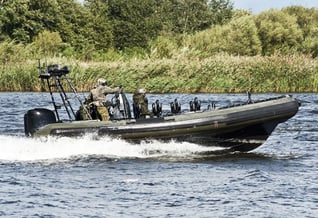
Inflatable recreational products including boats, paddle boards, kayaks, and pool toys require airtight seams across PVC or drop-stitch fabrics. The welding requirement for inflatable watercraft is stringent because seam failure directly risks user safety. Miller Weldmaster hot air welding machines produce the multi-layer lap seams and bladder seals used in recreational and commercial inflatable product manufacturing. For boats, rafts and other inflatables, see our inflatable welding machines.
Flexible Storage Tanks and Bladders
Flexible liquid storage tanks used for fuel, water, chemicals, and agricultural inputs are welded from heavy-gauge PVC, TPU, or polyurethane coated fabrics. These products require large-format welding capability and the ability to handle material thicknesses well above what standard machines accommodate. Miller Weldmaster machines can be configured for the seam widths and material weights that industrial bladder manufacturers require. Machines for tanks and bladders include the RFlex, BT2000, Bi-Directional and 104 Traveling Welder.
Prototype and Short-Run Specialty Welding
Not every application is a production run. Miller Weldmaster works with manufacturers who are developing new thermoplastic products and need welding capability for prototyping and pre-production validation. If you have a concept and a material but no established welding process, our applications team can work through the weld development process with you before you commit to production equipment. For RF prototypes, Miller Weldmaster offers the RFlex Press.
How Do You Choose the Right Welding Technology for a Specialty Application?
| Technology | Best For | Material Compatibility | Speed Profile |
|---|---|---|---|
| Hot Air Welding | Curved seams, variable thicknesses, versatile production | PVC, TPU, PE, PP, coated fabrics | Medium to high; suitable for most specialty applications |
| Hot Wedge Welding | Long straight seams at high speed, heavy materials | PVC, PE, PP, thick coated fabrics | High speed; ideal for roller doors, tarps, agricultural curtains |
| Impulse Welding | Short seams, thin films, precision work, low-volume | PVC, PP, PE, polyurethane films | Lower throughput; suited to prototyping and short runs |
| RF (Radio Frequency) Welding | Complex shapes, intricate welds, medical and inflatable products | PVC, TPU, PU polar thermoplastics | Variable; allows re-weld and die-based shaping |
What Happens During a Miller Weldmaster Applications Assessment?
Before any machine recommendation, Miller Weldmaster runs a structured applications assessment. This is not a sales call. It is a technical process:
- Material evaluation: you submit a sample of your thermoplastic fabric; the applications team verifies weldability and identifies the temperature and pressure range
- Seam geometry review: straight, curved, hem, overlap, or multi-layer seam requirements drive technology selection
- Production volume analysis: daily output targets determine whether a standard, semi-automated, or fully automated configuration is appropriate
- Machine recommendation: a specific machine or custom configuration is proposed, often with a demo available before purchase commitment
- Test weld validation: production-representative test welds are run to confirm seam strength and process parameters before the machine is built or delivered
This process reduces the risk of acquiring equipment that does not match your production requirements.
Why Do Specialty Manufacturers Choose Miller Weldmaster?
There are generic welding equipment suppliers. Miller Weldmaster is not one of them. Since 1974, the company has built its reputation specifically in thermoplastic fabric welding, across both standard industry applications and the custom, unusual, and prototype-stage challenges that come with specialty manufacturing.
Over 50 Years of Applications Experience Across Diverse Industries
Since 1974, Miller Weldmaster has worked with manufacturers across aerospace, defense, agriculture, food processing, environmental containment, recreation, and dozens of other sectors. This breadth of applications experience is directly relevant to specialty manufacturers: there is a strong probability that a production challenge similar to yours has already been solved, and the solution is documented. Our team draws on this history when assessing new applications rather than approaching each project from scratch.
Custom Automation Capability for High-Volume Production
Standard machines cover most applications. But when production volume, labor cost, or seam consistency requirements push beyond what a standard configuration can deliver, Miller Weldmaster engineers custom automated solutions. These machines integrate material handling, weld control, and often cutting or folding operations into a single production line. Over 250 custom automated machines have been deployed worldwide. For specialty manufacturers scaling from prototype to production, this capability means you can grow into higher automation without switching suppliers.
Technology Breadth Means One Supplier for Multiple Challenges
Many specialty manufacturers work across multiple product types, each with different material and seam requirements. Miller Weldmaster offers hot air, hot wedge, impulse, RF, and ultrasonic welding technologies, plus industrial sewing, under one roof. This means you can source equipment for different production lines, or combine technologies on a single custom machine, without managing multiple vendor relationships.
A custom fabric welding machine can combine several of these methods in one system.
Service, Spare Parts, and Training After the Sale
Machine uptime is a production metric. Miller Weldmaster maintains an in-house service team and a spare parts inventory that ships quickly. Remote technical support and on-site training are available for every machine in the product line. For specialty manufacturers where the welding machine is a critical process step, this post-sale support is part of the total value of the equipment, not an add-on.
What Makes Specialty Welding Applications More Difficult to Configure?
Specialty applications introduce variables that standard industry setups do not encounter as often. Understanding these variables is part of why an experienced applications team matters.
Unusual Seam Geometries
Unusual seam geometries are the most common challenge in specialty welding. Containment booms require reinforced seams around attachment hardware. Military shelter panels require curved seam paths across large-format materials. Evacuation slides require precise seam placement on non-flat surfaces. Hot air welding handles irregular seam paths better than hot wedge technology, which excels on straight seams. Understanding this distinction upfront prevents equipment selection errors.
Materials Outside the Standard Range
Non-standard materials including multi-layer military laminates, flame-retardant coated fabrics, and highly plasticized PVC blends require individual evaluation before a temperature or pressure setting can be confirmed. Miller Weldmaster does not apply generic parameters to specialty materials. Every unfamiliar material goes through test welding before production parameters are locked.
Regulatory and Certification Requirements
Regulated applications such as aviation evacuation equipment, food-contact conveyor belts, and military-specification products impose external documentation requirements. Weld parameters must be recorded, seam strength must meet stated minimums, and in some cases the welding process must be formally validated.
What Is the Process for Getting a Custom Welding Machine from Miller Weldmaster?
The path from initial inquiry to a running production machine follows a clear process. Here is what to expect:
Step 1 – Contact and Initial Review
Describe your product, material, and production requirement to the Miller Weldmaster sales team via the contact form or phone. The team will identify whether a standard machine, a configured standard machine, or a fully custom solution is the right starting point.
Step 2 – Material and Application Assessment
Submit a fabric sample if you have one. The applications engineering team evaluates the material, runs preliminary test welds, and develops initial parameter recommendations.
Step 3 – Machine Proposal
Based on the assessment, Miller Weldmaster proposes a specific machine or custom configuration with a defined scope of work, lead time, and price.
Step 4 – Demo or Validation Weld
Where possible, a pre-purchase demonstration is available. You see the machine produce your seam on your material before committing to the purchase.
Step 5 – Build and Delivery
Standard machines ship from stock or with short lead times. Custom machines are built to your specification with defined milestones and factory acceptance testing before shipment.
Step 6 – Installation and Training
Miller Weldmaster service team installs the machine and trains your operators on-site. Ongoing remote support is available from day one of production.