About Filtration Tube and Bag Welding Machines
Filtration tube and bag welding equipment is industrial machinery that uses controlled heat to form and seal non-woven filter media into tubes and bags — replacing manual sewing with automated, repeatable welds that produce stronger, leak-resistant seams at higher production rates. For manufacturers producing dust collector bags, baghouse filter socks, or liquid filtration bags, the choice between welding and sewing has direct consequences for seam integrity, production speed, and product quality. This guide covers how filtration welding equipment works, which welding method suits different filter media types, what to look for when evaluating equipment, and how Miller Weldmaster — a U.S.-based manufacturer of fabric welding equipment since 1974 — designs and builds systems to meet the specific demands of filter tube and bag production.
Key Takeaways
- Filtration tube and bag welding equipment uses heat-based welding to seal non-woven filter media, eliminating needle holes and thread contamination that cause seam leakage in sewn bags.
- Automated filter tube welding systems increase production rates significantly compared to manual sewing. Apex Filtration and Environmental reported a 30% production increase after deploying two Miller Weldmaster machines.
- Hot air welding is the most widely used method for non-woven filter media; the right technology depends on fabric type, tube diameter, and target production volume.
- Miller Weldmaster builds filtration welding equipment in the U.S. and engineers systems to customer-specific diameter, length, and automation requirements.
- Welded filter bag seams eliminate bypass leakage paths, reduce fiber contamination, and extend service life compared to stitched alternatives — advantages that are especially critical in pharmaceutical, food and beverage, and chemical processing applications.
Understanding Filter Manufacturing Methods
Filter Tubes vs. Filter Bags — What's the Difference?
Filter tubes and filter bags share similar construction methods but serve different filtration applications. Filter tubes are cylindrical media formed by welding the longitudinal seam of a flat fabric sheet around a mandrel, then cutting the tube to length. They are commonly used in dust collection, baghouse, and HVAC systems.
Filter bags are closed-end tubes with a sealed bottom and, in many cases, a ring or flange at the top for mounting. They are widely used in liquid filtration for chemical processing, pharmaceutical, food and beverage, and industrial water treatment applications.
Both products depend on precise seam construction. Tubes primarily handle air and gas-phase filtration, while bags may handle air or liquid filtration where a sealed end and mounting collar are required.
Why Manufacturers Are Moving from Sewing to Welding
The shift from sewn to welded seams in filter manufacturing is driven by performance and consistency. Sewing repeatedly penetrates the fabric, creating stitch holes that can become leakage paths under operating pressure. Thread can also shed into filtered fluid, creating contamination concerns in pharmaceutical and food processing applications.
Welded seams form a continuous bond with no needle holes or thread. This distributes stress more evenly across the seam, improving burst strength, service life, and consistency from bag to bag.
For high-volume producers, automation adds another advantage. Automated welding systems run continuously, cut to programmed lengths, and maintain consistent seam parameters across thousands of cycles, reducing the variability and labor demands associated with manual sewing.
When to Use Industrial Sewing Instead of Welding?
Heat welding is not compatible with every filter media type. Some materials cannot be reliably fused with heat welding, and attempting to weld them can lead to seam failure, material degradation, or inconsistent bond strength.
Materials that typically require sewing include certain PTFE woven constructions, fiberglass filter fabrics, Nomex (aramid) media, and some high-temperature specialty composites where thermoplastic content is insufficient or absent for reliable heat fusion.
Miller Weldmaster offers industrial sewing capabilities alongside welding, allowing manufacturers to handle both weldable and non-weldable filter media through a single equipment supplier. For operations producing multiple filtration products across different media types, this flexibility can simplify production planning and reduce the need to source separate machine platforms.
Welding Methods Used for Filter Tube and Bag Production
Hot air welding seals the long seam of filter tubes on Miller Weldmaster's T300 Extreme Filter System; ultrasonic welding closes bag ends, hot wedge suits heavier non-wovens, and sewing covers media that can't be heat-welded.
| Welding Method | How It Works | Best For (Filter Media Type) | Primary Application | Automation Level |
|---|---|---|---|---|
| Hot Air Welding | A heated air stream fuses the thermoplastic seam as fabric passes through or over the nozzle | Non-woven polyester, polypropylene, PTFE-laminated needle felt | Continuous longitudinal tube seam; roll-to-roll production | High — suited to full automation |
| Ultrasonic Welding | High-frequency vibration heats the seam so the layers fuse; the bag end can be welded and cut in one pass | Non-woven polyester and polypropylene filter bags | Radius-welded bag ends (bottoms) | High — added to a T300 continuous line |
| Hot Wedge Welding | A heated wedge contacts the fabric at the seam, melting both surfaces before they are pressed together | Heavier thermoplastic non-wovens, multi-layer constructions | Overlap or fin seams on heavier filter media | Medium-High |
| Industrial Sewing | Thread is stitched through the fabric using industrial sewing heads | PTFE woven constructions, fiberglass, Nomex, non-weldable media | Seams where heat welding is not compatible with the media | Medium — semi-auto sewing heads available |
Key Features to Look for in Filter Tube and Bag Welding Equipment
Overview
Evaluating filtration welding equipment requires looking past the spec sheet. The machines that deliver long-term value are the ones engineered for the specific demands of your filter product — your tube diameter range, your media type, your production volume, and your labor structure. Here are the key capabilities to evaluate.
Tube Diameter Range and Size Flexibility
Filter tube production spans a wide range of diameters — from small cartridge-style tubes to large-diameter baghouse socks. Equipment configured for a fixed diameter is limiting for any manufacturer producing multiple filter sizes or expecting product line changes over the machine's service life.
Look for systems that support quick-change tooling, adjustable mandrels, or configurable forming heads that allow the same base machine to produce tubes across a diameter range. Miller Weldmaster configures filtration welding systems to customer-specified diameter requirements, which means the machine is spec'd to your current production needs rather than a generic range.
Automated Cutting and Length Control
In manual or semi-automatic filter tube production, cut-to-length is often a separate downstream step — an operator measuring and cutting each tube individually. That step is a labor cost and a source of length variation.
Automated filtration welding systems with integrated cutting eliminate that step entirely, and automated welding systems for filter tubes and bags are specifically engineered to provide this kind of continuous, integrated production. Programmable length settings allow operators to dial in the target tube length, and the machine cuts with precision and repeatability on every cycle. The result is a finished tube coming off the end of the line without additional handling — which is one of the primary reasons automated systems produce higher output per labor hour than semi-automatic or manual alternatives.
This is the type of automation improvement that produces measurable production gains, especially when leveraging filter welding systems designed to increase output in demanding industrial air filtration environments.
Multi-Roll Welding Capability
Some filtration welding systems support welding multiple rolls of filter media simultaneously — either the same material at the same thickness for higher output volume, or different thicknesses in a single pass for laminated or multi-layer filter constructions, which is especially beneficial when processing non-woven polyester and polypropylene media for filtration products. Multi-roll capability is a meaningful differentiator for high-volume producers who need to maximize throughput on a single machine footprint.
PLC Control and Programmable Welding Parameters
Programmable logic controller (PLC) systems give operators direct control over the welding parameters that determine seam quality: temperature, feed speed, dwell time, and pressure. Storing these parameters as named programs for different material and product configurations means an operator can switch between filter products by selecting a saved program rather than manually re-tuning the machine, helping maintain uniform results from run to run.
PLC control also reduces the skill requirement for day-to-day machine operation. Once a welding program is validated for a given material and tube specification, the machine runs consistently to those parameters without relying on operator judgment for temperature or speed settings, supporting optimal performance across shifts and product changeovers. This is particularly valuable in production environments with high operator turnover or multiple-shift operations.
Hybrid Weld-and-Sew Capability
Miller Weldmaster designs filter systems that weld, sew or do both: the T300 Extreme Filter System offers automated sewing as an add-on, and Filter Sewing Solutions builds sewing into a filter line. That is a genuine production advantage for filter manufacturers who work across multiple media types.
A filter bag production operation might weld polyester needle felt tubes using hot air welding, then sew the top ring onto a PTFE-laminated bag from the same equipment supplier. Hybrid capability means one supplier, one service relationship, and one parts inventory — rather than separate machines from separate vendors running different media types on parallel lines.
Industries and Applications for Filtration Welding Equipment
Filtration tube and bag welding equipment serves any manufacturing operation producing filter products from thermoplastic non-woven media. The specific machine configuration varies by industry — baghouse filter bags have different dimension requirements than pharmaceutical liquid filter bags, for example — but the core production challenge is the same: consistent, leak-resistant seams at production speed.
Dust Collection and Baghouse Systems
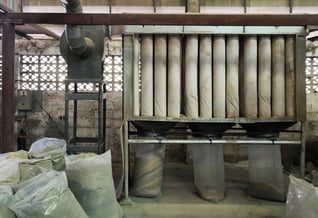
Baghouse filter bags are a major application for filtration welding equipment and are widely used in cement plants, steel mills, power generation, grain handling, and other heavy industrial environments.
These bags must withstand sustained pressure and repeated cleaning cycles from pulse-jet or shaker systems. Welded seams distribute stress more evenly than sewn seams and help improve durability.
Common media include polyester needle felt, polypropylene, PPS (Ryton), and PTFE-laminated constructions. Hot air welding is commonly used for non-woven polyester and polypropylene bags.
HVAC and Air Filtration
HVAC and air filtration systems often use shorter, smaller-diameter filter tubes in commercial buildings, clean rooms, and industrial ventilation systems.
Seam quality is critical because needle holes or inconsistent seams can allow particulates to bypass the filter media and reduce filtration efficiency.
Automated welding creates consistent seam width and bond strength while supporting repeatable production. For high-volume manufacturers, integrated hot air welding and cutting improves throughput, consistency, and labor efficiency across standard filter tube sizes.
Liquid Filtration Bags
Liquid filter bags are used in chemical processing, pharmaceutical manufacturing, food and beverage production, industrial water treatment, and petroleum refining.
In these applications, eliminating needle holes can be essential for contamination control. Stitch holes may allow unfiltered fluid to bypass the bag wall, while sewn thread can shed fibers into the filtered liquid.
Welded construction eliminates both issues by forming a sealed seam with no penetrations and no thread, helping improve contamination control, strength, and consistency.
Custom and OEM Filtration Products
OEM filter manufacturers and custom filtration product producers often need equipment configured for unique specifications and custom system design: non-standard tube diameters, unusual length ranges, specialized flange or ring attachment requirements, or media types not served by off-the-shelf machine configurations.
Miller Weldmaster's engineering team designs custom converting and welding equipment from the ground up when standard configurations don't fit the application. Eichrom Technologies, a specialty filtration manufacturer, describes the experience: "The team at Miller Weldmaster made our vision, their vision and turned a 'back of the napkin' drawing into the fantastic hot-air sealer that we use in production today. The collaborative and consultative environment at Miller Weldmaster is second to none."
Comparing Welded vs. Sewn Filter Bags
Welded and sewn filter bags differ in how their seams are formed and how those seams perform in demanding filtration environments. Welded construction eliminates stitch holes and thread, helping reduce potential leakage paths and contamination risk while providing consistent seam strength. Sewn construction remains important for filter media that cannot be reliably heat welded, making the right choice dependent on material, application, and production requirements.
| Performance Factor | Welded Seams | Sewn Seams |
|---|---|---|
| Seam integrity / bypass risk | Continuous molecular bond — no holes, no leakage paths | Stitch holes create potential bypass paths that widen over time |
| Fiber / thread contamination | No thread — zero contamination risk from seam construction | Thread can shed into filtered fluid; significant risk in pharma and food applications |
| Seam strength under pressure differential | Load distributed evenly across the full seam length | Stress concentrates at individual stitch points; higher fatigue risk |
| Production speed | Faster — automated welding runs continuously at high speed | Slower — sewing speed is limited; manual handling between steps adds time |
| Consistency across production runs | High — PLC-controlled parameters produce identical seams | Variable — depends on operator, thread tension, machine calibration |
| Service life | Longer — stronger seams, no thread degradation | Shorter in demanding applications; thread degrades under chemical exposure or heat |
| Material compatibility | Thermoplastic non-wovens: polyester, polypropylene, PTFE-laminated media | All media types including non-weldable: fiberglass, Nomex, certain PTFE constructions |
How to Choose the Right Filtration Welding Machine — A Buyer's Checklist
Selecting a filtration welding machine is a capital decision with a multi-year production impact. The right approach starts with defining your product requirements before evaluating equipment options. Here is a practical six-step process.
Step 1 – Define Your Filter Product Specifications
Identify whether you are producing filter tubes, filter bags, or both. Document the diameter range, length range, and wall construction (single-layer, multi-layer, laminated). Specify the daily or weekly production volume target — this determines whether semi-automatic or fully automated equipment is appropriate.
Step 2 – Identify Your Filter Media
The filter media you are welding determines which welding method is compatible. Non-woven polyester and polypropylene are suitable for hot air welding. Multi-layer or heavy-weight constructions may require hot wedge welding. Non-thermoplastic media (fiberglass, Nomex) require sewing. Confirm media compatibility with the equipment supplier before specifying a machine.
Step 3 – Determine Your Seam Requirements
Map out all the seam types your filter product requires: longitudinal tube seam, bottom seal, top flange or ring attachment, or mid-tube seams for baffled constructions. Some of these require different welding methods — for example, continuous hot air welding for the tube seam and ultrasonic welding for a radius-welded bag end. A complete seam map lets you evaluate whether you need a single-process machine or a multi-step production line.
Step 4 – Assess the Automation Level You Need
Semi-automatic systems require an operator to load and position material between cycles. Fully automated systems run roll-to-roll with the operator monitoring rather than handling material. The right level depends on your volume, your labor cost structure, and whether you need consistent output across multiple shifts. Higher automation requires a larger upfront investment but lowers cost per unit and reduces seam variability.
Step 5 – Evaluate the Equipment Supplier
Ask whether the manufacturer builds equipment in the U.S. or overseas, what customization is available for non-standard product specs, how spare parts are supplied, and whether the supplier provides installation, training, and ongoing technical support. For a capital equipment purchase, the supplier relationship matters as much as the machine specification.
Step 6 – Request a Machine Demonstration or Production Trial
Before finalizing a capital equipment decision, ask to run your actual filter media on the machine under consideration. A capable supplier will accommodate a material test to demonstrate seam quality, production speed, and cut accuracy on your specific fabric and tube dimensions. Do not purchase a machine without seeing it run your material.
Miller Weldmaster Filtration Welding Equipment
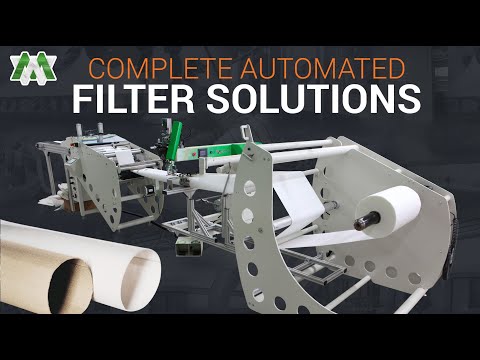
Miller Weldmaster's main filtration machine is the T300 Extreme Filter System, which unwinds, welds and cuts filter tubes automatically at up to 100 feet (30 m) per minute. Filter tube and bag manufacturers face the same core challenge regardless of their application: producing consistent, leak-resistant seams at a speed and cost that makes their operation viable. Miller Weldmaster builds filtration welding systems specifically for this challenge — engineered for the filter media types, tube dimensions, and production volumes of industrial filtration manufacturing, and built in the U.S. with domestic support and spare parts.
Miller Weldmaster's filtration machines include the T300 Extreme Filter System (unwinds, welds and cuts filter tubes automatically), Filter Ultrasonic Welding (radius-welds filter bag ends on a T300 continuous line), Filter Sewing Solutions (automated sewing built into a filter line), the Triad Extreme High-Speed hot wedge welder, the portable Triad Extreme Universal wedge welder and the T300 Flex hot air and hot wedge welder. Complete automated tube and bag lines are on the automated filter production page, and every filtration machine is in the machine finder.
T300 Extreme Filter Tube Welding System
The T300 Extreme Filter System is Miller Weldmaster’s purpose-built automated solution for filter tube production. It uses hot air welding to form and seal non-woven filter media in a continuous cycle as fabric feeds from a roll, forms around a mandrel, is welded, and cut to a programmed length.
The system is configured around the customer’s required tube diameters and lengths rather than a fixed specification. Multiple sizes can be accommodated through tooling configurations, allowing the machine to match specific production requirements.
The production impact can be significant. Apex Filtration and Environmental reported a 30% increase in production after deploying two Miller Weldmaster machines, noting: “It has been a pleasure working with Miller Weldmaster and your team. We currently have 2 machines that has helped us increase our production by 30%.”
For manufacturers looking to increase output while maintaining repeatable seam quality, the T300 Extreme provides a scalable path to automated filter tube production.
Custom & Automated Welding Systems for Filtration Manufacturing
When a standard machine configuration does not fit the application, Miller Weldmaster develops custom filtration welding systems around specific production requirements. This can include non-standard tube diameters, unusual media combinations, multi-roll welding, and integrated systems that combine forming, seaming, cutting, and assembly.
The engineering process is collaborative. Miller Weldmaster works directly with manufacturers to understand the filter product, production environment, and output goals, then designs the system around those needs.
Eichrom Technologies describes that process well: “The team at Miller Weldmaster made our vision, their vision and turned a ‘back of the napkin’ drawing into the fantastic hot-air sealer that we use in production today.” For manufacturers with unique requirements, the process starts with the product and production goals—not a catalog.
This approach gives manufacturers a purpose-built system designed to support both current production needs and future growth.