CIPP liner fabrication equipment controls how liner material is cut, formed, and welded into a finished tube, and the precision of each step directly determines whether that liner holds structural integrity during installation and service.
In cured-in-place pipe rehabilitation, fabrication accuracy is not simply a quality preference. It is a structural requirement. Small variations in cut width, seam alignment, feed speed, or weld consistency can affect how the liner seats against the host pipe wall, how resin distributes through the tube, and whether the finished liner achieves the designed load-bearing capacity after cure. Companies investing in reliable CIPP liner production equipment must evaluate fabrication precision as a direct contributor to rehabilitation performance, not just manufacturing efficiency.
Key Takeaways: Why Fabrication Precision Determines Rehabilitation Outcomes
- Liners cut or welded outside dimensional specification can fail under inversion pressure before resin cure is complete, resulting in costly re-lining and project delays.
- Seam consistency determines how evenly resin distributes throughout the liner wall, directly impacting structural strength after cure.
- Automated CIPP liner fabrication equipment reduces tolerance variation across long production runs more effectively than manual fabrication methods.
- The choice between overlap and butt seam configurations affects liner wall uniformity, pipe fitment, and dimensional consistency.
- In-house liner fabrication allows contractors and manufacturers to control material specifications, dimensional tolerances, and production quality directly.
What Is CIPP Equipment and Liner Fabrication Equipment?
CIPP liner fabrication equipment refers to the industrial machinery used to cut, form, weld, sew, and seal raw liner materials into finished cured-in-place pipe tubes for trenchless rehabilitation applications.
This equipment category includes unwind systems, precision cutting controls, seam-forming guides, welding or sewing stations, feed systems, and quality-control components designed specifically for liner manufacturing. Unlike broader CIPP equipment categories and installation-side pipe lining equipment or other lining equipment such as inversion drums or curing units, fabrication equipment focuses entirely on producing dimensionally accurate liners before they ever reach the field.
Defining the Equipment Category
CIPP liner fabrication involves multiple stages working together as a coordinated production system. A complete fabrication line may include:
- Material unwind systems
- Tension-control systems
- Precision cut-to-width stations
- Overlap or butt seam forming systems
- Hot air welding heads or industrial sewing heads
- Inline guiding and tracking systems
- Roll-up and packaging stations
- Quality inspection systems
The goal of the equipment is to convert flat raw material rolls into finished tubular liners capable of withstanding inversion pressures, curing temperatures, and long-term structural loads underground, while holding up during installation work in pipes, maintaining flow after cure, and supporting long-term durability.
Manufacturers such as Miller Weldmaster design fabrication systems specifically for the demands of trenchless rehabilitation production environments, where dimensional consistency across long runs is critical.
How Fabrication Equipment Fits into the CIPP Production Workflow
The fabrication process begins with raw liner material and ends with a finished tube ready for impregnation and installation.
The installation process can start after fabrication, and inversion equipment may use pressurized air or water to turn the resin-impregnated liner inside out in the host pipe.
- Raw material unwind
- Material tension stabilization
- Precision width cutting
- Seam alignment and forming
- Welding or sewing
- Seam inspection and quality verification
- Tube rolling and packaging
| Step | Equipment Function | Accuracy Requirement | Consequence of Deviation |
|---|---|---|---|
| Material Unwind | Controls roll feed and tension | Stable material tracking | Wrinkles and seam drift |
| Width Cutting | Establishes liner circumference | Precise dimensional tolerance | Improper pipe fit |
| Seam Forming | Aligns edges for joining | Consistent overlap or butt alignment | Variable wall thickness |
| Welding/Sewing | Creates structural seam | Uniform bond or stitch integrity | Seam failure |
| Guiding System | Maintains lateral tracking | Stable seam positioning | Inconsistent seam width |
| Final Roll-Up | Packages finished liner | Controlled tension | Tube deformation |
A failure at any stage can create downstream installation or performance problems that may not become visible until the liner is under inversion pressure or fully cured underground.
Why Cutting Accuracy Is a Structural Issue, Not Just a Quality One
Most discussions about CIPP liner manufacturing focus on productivity, seam type, or machine speed. However, the most important factor is often the least discussed: dimensional accuracy.
When a liner is fabricated outside specification, the resulting geometric errors affect how the tube behaves during installation and cure. A liner that does not properly conform to the host pipe wall cannot distribute structural loads correctly after curing.
How Cut Width Deviation Affects Liner Geometry
When a liner is cut narrower than specification, it cannot fully press against the host pipe wall during inversion, leaving unsupported gaps where the cured liner carries no structural load.
The geometry of a CIPP liner is directly tied to its cut width. Even a small dimensional variation can significantly alter the circumference once the material is formed into a tube.
A liner cut too narrow may:
- Fail to fully contact the pipe wall
- Create unsupported voids
- Reduce final structural stiffness
- Cause improper resin distribution
A liner cut too wide may:
- Wrinkle during inversion
- Fold during curing
- Produce uneven wall thickness
- Create weak structural zones
These issues become more severe as pipe diameters increase and production runs extend over longer lengths.
Properly fabricated liners maintain:
- Uniform circumference
- Consistent wall contact
- Predictable resin distribution
- Stable curing behavior
Off-spec liners introduce variability that directly affects rehabilitation performance, and required tolerances vary depending on pipe size and application needs.
Seam Consistency and Resin Distribution
Seam quality is about more than whether the seam holds together mechanically. It also affects how resin flows through different resin types and saturates the liner structure.
Inconsistent welds can produce:
- Variable seam thickness
- Uneven density zones
- Inconsistent permeability
- Resin pooling or starvation
When resin saturates unevenly, portions of the liner wall may fail to achieve the required structural properties defined by standards such as ASTM F1216.
Temperature drift, inconsistent welding pressure, and feed-speed variation all contribute to seam inconsistency. Over long production runs, even minor variations can accumulate into significant structural differences throughout the liner length.
This is why automated seam control systems are increasingly important in modern automated CIPP liner production.
The Cost Consequence: Re-Lining After Premature Failure
Fabrication errors carry substantial financial consequences.
When a liner fails during installation or shortly after service begins, contractors face:
- Mobilization costs
- Traffic control costs
- Bypass pumping expenses
- Replacement liner costs
- Additional installation labor
- Reputation damage
- Project delays
Unlike many manufacturing defects, a failed CIPP liner cannot simply be repaired easily once installed underground. In many cases, full replacement is required.
The cost of accurate fabrication equipment is often far lower than the cost of even a single failed rehabilitation project.
Welding vs. Sewing: Which Fabrication Method Suits Your Application?
The choice between welding and sewing depends primarily on liner material construction and application requirements.
Neither method is universally better. The correct approach depends on:
- Material composition
- Pipe diameter
- Structural requirements
- Production volume
- Required seam characteristics
What Hot Air Welding Produces and Where It Excels
Hot air welding uses controlled heat, pressure, and feed speed to bond thermoplastic-coated liner materials into a continuous seam.
Compatible materials may include:
- PVC-coated felt
- TPU-coated materials
- TPO-coated liners
- Polyurethane-coated fabrics
A welded seam provides:
- Continuous fused bonding
- No needle penetrations
- Consistent seam geometry
- High production speed
- Reduced operator variability
Hot air welding technology is commonly used for coated liner systems where uniform seam integrity and high-volume throughput are priorities.
Temperature consistency and feed-speed accuracy are critical because underheating weakens the bond while overheating can degrade the material itself.
Where Industrial Sewing Remains the Right Choice
Some liner materials cannot be thermally bonded.
Non-woven felt liners without thermoplastic coatings must typically be sewn using industrial stitching systems.
Industrial sewing remains effective for:
- Felt-only liners
- Smaller diameter applications
- Certain specialty liner constructions
- Lower-volume production environments
Sewing precision still matters significantly. Thread tension, stitch density, and seam alignment all affect structural reliability.
A sewn seam should never be treated as a lower-precision option. Poor stitch consistency can create failure points just as easily as poor welding.
| Factor | Welded Seam | Sewn Seam |
|---|---|---|
| Compatible Materials | Thermoplastic-coated materials | Uncoated felt materials |
| Seam Construction | Continuous fused bond | Mechanical stitched joint |
| Needle Penetrations | None | Present |
| Production Speed | Higher | Moderate |
| Wall Uniformity | More uniform | Depends on stitch profile |
| Best Applications | High-volume coated liners | Felt-only liner systems |
Seam Configuration: Overlap vs. Butt and What Each Means for Liner Uniformity
Seam configuration affects both fabrication efficiency and final liner geometry.
The two most common seam configurations are:
- Overlap seams
- Butt seams
Each produces different structural and dimensional characteristics.
Overlap Seam: Double Thickness at the Join
Overlap seams are created by laying one material edge over another before welding or sewing.
This produces:
- A strong joining surface
- Easier fabrication setup
- Broader material compatibility
- Simpler machine configuration
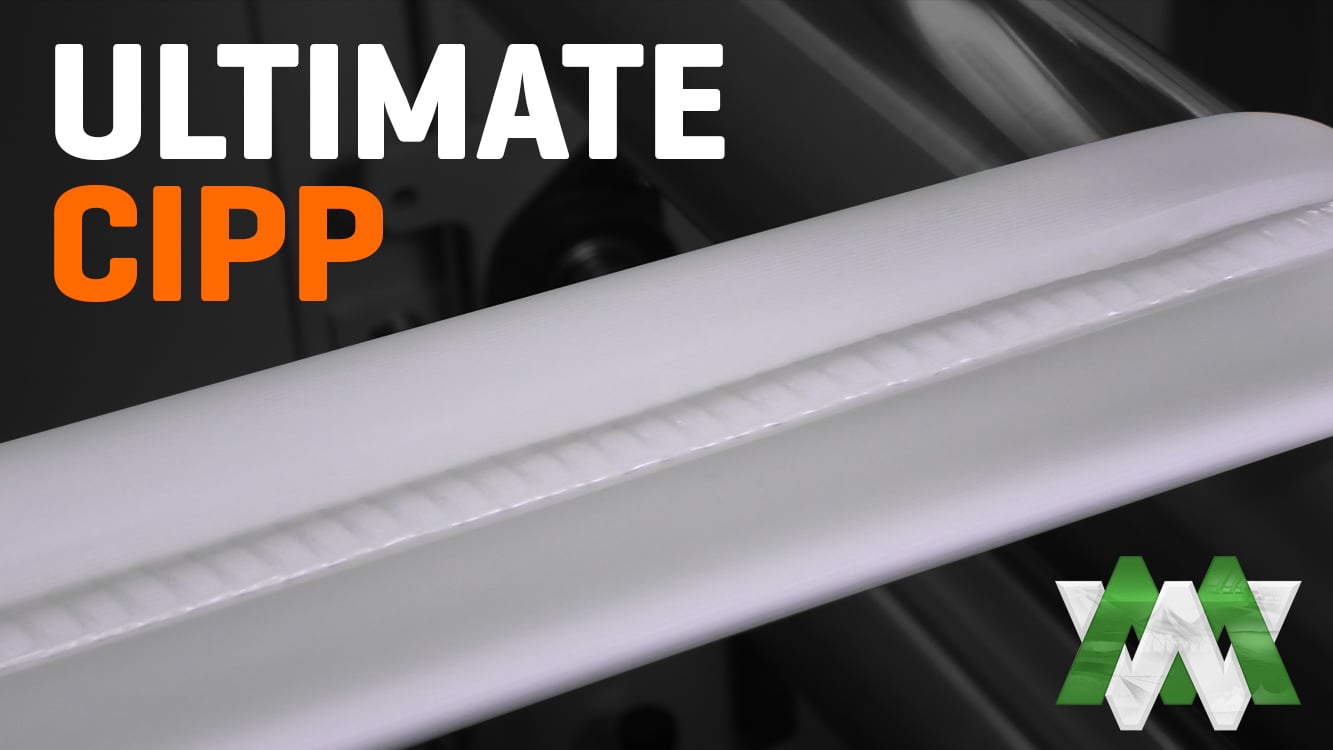
However, overlap seams also create a double-thickness ridge along the seam line.
In smaller pipe diameters, this thickness variation may:
- Affect liner seating
- Create localized pressure variation
- Influence resin distribution
Overlap seams remain common because they are versatile and compatible with many production systems.
Butt Seam: Edge-to-Edge Joining for Uniform Wall Thickness
Butt seams join material edges directly together without overlap.
This produces:
- Uniform wall thickness
- Reduced seam ridge
- More consistent liner geometry
- Better dimensional uniformity
However, butt seams require:
- Precise edge alignment
- Stable material tracking
- Accurate lateral positioning
- Higher fabrication precision
For structural-class liners and larger diameter systems where wall consistency is critical, butt seams are often preferred.
Equipment Features That Directly Control Fabrication Accuracy
Not all fabrication equipment delivers the same level of precision, and different cipp lining equipment and cipp lining applications require different feature sets.
Specific machine features directly determine how consistently a production line can maintain dimensional accuracy across long runs.
Precision Unwind Systems and Tension Control
Material tension begins affecting accuracy before the seam is ever formed.
Inconsistent unwind tension can cause:
- Material stretching
- Width variation
- Wrinkling
- Tracking drift
Precision unwind systems stabilize material feed so the liner enters the welding or sewing zone consistently.
This becomes especially important for long production runs where minor tension changes accumulate over hundreds of feet.
Temperature Consistency Across the Welding Head
Weld quality depends heavily on stable temperature control.
Temperature inconsistency creates:
- Under-bonded zones
- Overheated brittle areas
- Variable seam strength
- Inconsistent seam appearance
Closed-loop temperature control systems continuously monitor and regulate heat output across the seam width to maintain bond consistency.
This is especially important for heavier coated liner materials used in trenchless rehabilitation applications.
Feed Speed Accuracy and Material Throughput Consistency
Feed speed determines how long the material remains under the welding head.
If feed speed varies:
- Bond quality changes
- Seam strength fluctuates
- Production consistency decreases
Automated feed systems maintain stable dwell time regardless of material weight or roll variation.
This consistency becomes increasingly important in automated CIPP liner production environments where production runs may continue for extended periods.
Inline Guiding Systems and Calibration Tubes for Lateral Accuracy
Material edges must remain aligned throughout the forming process.
Lateral drift causes:
- Variable seam width
- Misalignment
- Uneven overlap
- Structural weak zones
Inline guiding systems continuously correct edge positioning during production.
Without guiding systems, maintaining tight dimensional tolerances over long runs becomes extremely difficult.
| Machine Feature | What It Controls | Consequence If Absent |
|---|---|---|
| Unwind Tension Control | Material stability | Wrinkling and seam drift |
| Closed-Loop Temperature Control | Weld consistency | Under- or over-bonding |
| Feed Speed Automation | Dwell time consistency | Variable seam strength |
| Inline Guiding | Lateral seam alignment | Uneven seam width |
| Precision Cutting | Tube circumference | Poor pipe fitment |
| Seam Inspection Systems | Quality verification | Undetected defects |
For additional technical guidance, review CIPP liner welding machine selection and factors to consider when choosing a CIPP liner machine.
In-House CIPP Liner Fabrication: When It Makes Economic Sense
As rehabilitation demand grows across the pipe lining industry, more contractors and manufacturers are evaluating whether to fabricate liners internally rather than purchasing finished tubes.
The Case for In-House Fabrication
In-house fabrication offers several advantages:
- Reduced lead times
- Direct quality control
- Flexible production scheduling
- Custom dimensional control
- Lower long-term per-liner cost
- A full suite of supplier products, support, and expert training can help professionals adopt new systems, with hands-on guidance available on site for each job.
At sufficient production volumes, automated fabrication systems can significantly reduce dependence on outside liner suppliers.
Companies also gain control over:
- Material selection
- Seam configuration
- Dimensional tolerances
- Production quality standards
Some equipment partners also provide ongoing technical assistance plus sales and marketing resources, so key operational needs are covered after purchase and can help grow the business.
Custom fabrication equipment can further optimize production lines around specific liner requirements.
When Purchasing Liner Is Still the Right Call
In-house production is not the right solution for every contractor.
Purchasing finished liners may remain preferable when:
- Production volume is low
- Shop space is limited
- Capital budgets are constrained
- Specialized liner designs are required
- Internal staffing is limited
The decision should be based on production economics, project volume, quality-control priorities, and each contractor’s needs and locations.
Miller Weldmaster builds automated fabrication systems specifically for production-volume trenchless rehabilitation environments. Explore the full range of CIPP liner production equipment or Contact the Miller Weldmaster team if you are interested in discussing your application and fabrication system options.
Frequently Asked Questions About CIPP Liner Fabrication Equipment
What is CIPP liner fabrication equipment?
CIPP liner fabrication equipment consists of industrial machinery used to cut, form, weld, sew, and seal liner materials into finished cured-in-place pipe tubes. This equipment includes unwind systems, precision cutters, seam-forming guides, hot air welding systems, industrial sewing systems, quality-control components, and tools. These machines are used for manufacturing liners, not for field equipment use during installation or curing.
How does cutting accuracy affect CIPP liner performance?
A liner cut narrower than specification may fail to fully contact the host pipe wall during inversion, leaving unsupported gaps in the cured structure. A liner cut wider than specification may wrinkle or fold, creating uneven wall thickness. Both conditions reduce structural reliability and may require costly re-lining.
What causes CIPP liner seam failure during installation?
Seam failures typically result from fabrication inconsistencies such as under-bonded welds, excessive heat exposure, lateral seam drift, or inconsistent stitch density. After cure, robotic cutters may be used to reopen laterals during reinstatement by drilling out branch openings once the new liner has hardened into a solid pipe-within-a-pipe. These issues originate from equipment precision problems rather than material defects alone.
What is the difference between welded and sewn CIPP liners?
Welded liners use heat and pressure to fuse thermoplastic-coated materials into a continuous seam without needle penetrations. Sewn liners use industrial stitching for felt materials that cannot be thermally bonded. The correct method depends primarily on liner material construction. In practice, training for these systems typically covers installation techniques, equipment usage, and safety protocols for professionals.
Can manufacturers produce CIPP liners in-house?
Yes. Contractors and manufacturers with sufficient production volume can fabricate liners internally using automated fabrication systems built for their production needs. In-house production provides direct control over dimensions, material selection, seam quality, and scheduling while potentially reducing long-term production costs. Some systems can be mounted in trailers or other mobile setups depending on workflow requirements.
What materials and UV curing systems are used in CIPP liner fabrication?
Common liner materials include non-woven felt coated with PVC, TPU, TPO, polyurethane, or polyethylene. Fiberglass-reinforced liner systems are also used in some structural rehabilitation applications. Two-part epoxy resins have been the CIPP standard for decades, allowing cure speeds to be adjusted with different hardeners for changing temperatures. Vinyl ester resins harden with a powder activator and provide a reliable, waterproof repair option, though they are not as strong as epoxy. Material selection determines whether welding or sewing is the appropriate seam method.
What tolerances are required for CIPP liner fabrication?
Required tolerances depend on pipe diameter, liner design, and applicable structural standards such as ASTM F1216. Keep in mind that tolerance requirements also vary with the curing systems selected. Width tolerances must allow the liner to fully conform to the host pipe wall under inversion pressure while maintaining consistent wall thickness and seam integrity across the entire production run. In practice, uv curing systems are often faster and can reach cure in around 90 minutes, while ambient curing can be a perfect low-cost option because it needs no additional equipment but typically takes several hours. Inversion drum pressure rating and capacity should match the length and thickness of the line and use lightweight, high-capacity materials to ensure proper installation conditions.