Double Hem Banner Welding: How the DH7600 Helps Sign Shops Increase Production
In today's competitive sign and graphics industry, production efficiency matters just as much as print quality. As banner orders grow larger and turnaround times continue to shrink, many shops discover that printing isn't the bottleneck—finishing is.
One of the most time-consuming finishing processes is hemming. Traditionally, operators weld one edge of a banner, reposition the material, and repeat the process on the opposite side. While effective for lower production volumes, this extra handling quickly adds unnecessary labor and slows throughput.
Double hem banner welding eliminates that inefficiency by allowing both long edges of a banner to be welded simultaneously. The result is stronger finished products, fewer handling steps, and significantly higher productivity.
This guide explains what double hem banner welding is, how it works, the materials it supports, and why the Miller Weldmaster DH7600 has become an ideal solution for high-volume banner production.
Key Takeaways
- Double hem welding finishes both long edges of a banner in a single pass.
- Eliminating banner repositioning increases production efficiency and reduces labor.
- Heat-welded hems create durable, waterproof seams without adhesives or stitching.
- The DH7600 combines hot air and hot wedge technologies for maximum versatility.
- Multiple thermoplastic materials—including PVC-coated and laminated fabrics—can be processed with excellent results.
What Is Double Hem Banner Welding?
A banner hem is the folded edge around the perimeter of a finished banner that provides additional strength for mounting hardware such as grommets, rope, or pole pockets.
Instead of finishing each edge individually, double hem welding produces both long hems simultaneously during a single pass through the machine. This creates consistent, reinforced edges while dramatically reducing production time.
The additional layer created by the folded hem distributes stress more evenly throughout the banner, helping prevent edge failure caused by wind, tension, or repeated installation.
For outdoor graphics, construction signage, event banners, and large-format advertising, proper edge finishing is one of the biggest factors affecting product longevity.
Why Proper Banner Finishing Matters
Many banner failures don't occur in the printed image—they begin at the edges.
Weak edge construction can lead to:
- Grommets pulling through
- Material separation
- Fraying
- Premature replacement
- Customer complaints
Choosing the appropriate finishing method for each application ensures banners perform as expected while helping reduce costly remakes.
| Finish Method | Strength | Waterproof | Best Applications |
|---|---|---|---|
| Heat-Welded Hem | Excellent | Yes | Outdoor signage, high-volume production |
| Tape Hem | Moderate | No | Indoor and temporary graphics |
| Sewn Hem | High | No | Fabric and mesh materials |
| Flush Cut | Low | N/A | Framed displays or temporary use |
How Double Hem Welding Works
Double hem welding uses a banner welding machine that applies heat and pressure to permanently fuse thermoplastic materials together.
Depending on the material, manufacturers commonly use one of two heating methods, and weld width is one of the setup variables that must match seam requirements and banner finishing needs:
Hot Wedge Welding
A heated metal wedge, one of the heated elements that transfers energy into the material during welding, is positioned between the folded material layers. As the material moves through the machine, the welding surfaces reach the proper temperature before compression rollers permanently fuse the seam. Hot wedge systems can also produce pole pockets in addition to hems and overlaps.
Hot Air Welding
Instead of a heated wedge, controlled hot air softens the material immediately before pressure is applied. This process provides excellent flexibility across many banner materials and thicknesses.
Both methods produce waterproof molecular bonds that outperform adhesives in demanding outdoor environments.
Single-Pass vs. Traditional Banner Finishing
The greatest advantage of double hem welding isn't necessarily faster welding speeds—it's reducing material handling.
With traditional finishing:
- Weld the first edge.
- Remove the banner.
- Flip or reposition it.
- Align the second edge.
- Complete the second weld.
Every repositioning step requires additional labor while increasing the opportunity for alignment inconsistencies.
The DH7600 removes this entire process by welding both edges simultaneously.
For shops producing hundreds of banners every shift, those saved minutes quickly become hours of recovered production time, and that workflow gain matters even more on large banners, where each repositioning step takes more labor.
Compatible Materials for Double Hem Welding
Double hem welding is designed for thermoplastic banner materials that soften under heat and permanently fuse together, so it is not ideal for fabric banners that cannot be heat welded.
Common compatible materials include:
- PVC laminated banner material
- PVC-coated vinyl
- Woven polypropylene
- Woven polyethylene
- Polyurethane-coated fabrics
- Additional compatible thermoplastics
As more environmentally conscious materials enter the market, testing new substrates before full production remains a best practice to ensure optimal weld quality, especially with pvc free banner material where weldability can vary.
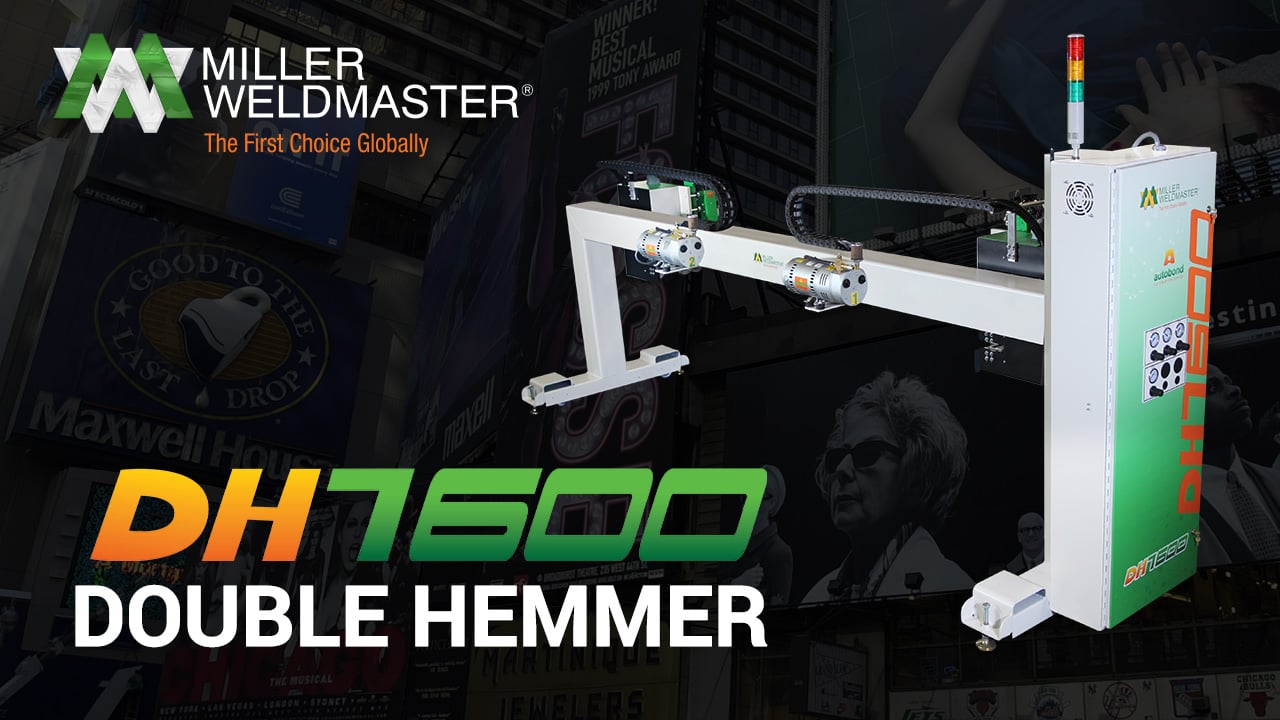
Meet the Miller Weldmaster DH7600
The DH7600 Double Hemmer was engineered specifically for manufacturers who require fast, repeatable, and consistent edge finishing.
By welding both outside edges simultaneously, this banner welder dramatically increases production capacity while reducing operator handling.
Its dual heating system combines both hot air and hot wedge technologies, giving manufacturers flexibility across numerous material types and production requirements.
Before installation, shops should confirm the machine’s power requirements, including appropriate electrical service and any compressed-air needs.
Key Features
- Dual hot air and hot wedge heating systems
- Simultaneous dual-edge welding
- Adjustable throat widths for multiple banner sizes
- PLC touchscreen with recipe storage
- Single-operator production
- Optional conveyor support for large-format material handling, improving workflow for banner stands and other display graphics
- Adjustable weld width from 0.5" to 2"
With welding speeds reaching approximately 60 feet per minute (18 m/min), the DH7600 is built to support continuous, high-volume production environments.
More Than Banner Production
Although designed with banner manufacturers in mind, the DH7600 is equally valuable for producing other flat thermoplastic products requiring simultaneous edge finishing, and the same approach is useful for vinyl banners and building wraps that need strong seams at scale.
Applications include:
- Billboards
- Large-format graphics
- Industrial covers
- Tarpaulins
- Containment booms
- Geomembranes
- Specialty industrial textiles
This versatility allows manufacturers to maximize equipment utilization across multiple product lines.
When Does a Double Hemmer Make Sense?
Not every shop requires a dedicated dual-edge finishing system, and for lighter output it may not always makes sense.
However, as production volumes increase, the savings become substantial.
Tape-based options can be more cost effective for low volume work, but automated welding becomes more cost effective as volume rises and labor cost accumulates.
A dual-edge machine is an excellent investment if your operation:
- Produces banners daily
- Handles frequent large-format graphics
- Has finishing departments creating production bottlenecks
- Wants to reduce labor costs without sacrificing quality
- Needs consistent seam quality across long production runs, using the industry standard for high-volume durable banner finishing
For shops where finishing limits overall throughput, increasing banner output often begins by removing unnecessary handling—not simply increasing weld speed.
Ready to Improve Your Banner Finishing Process?
If your production line is spending valuable time repositioning banners for a second pass, the DH7600 Double Hemmer can help streamline your workflow while producing consistent, high-quality results.
Contact the Miller Weldmaster team today to discuss your materials, production goals, and finishing requirements to determine whether the DH7600 is the right solution for your operation.
Conclusion
Banner finishing plays a critical role in both product durability and production efficiency.
Double hem banner welding allows manufacturers to produce stronger finished products while significantly reducing labor and material handling. By eliminating the need to reposition banners between welds, manufacturers can streamline production, improve consistency, and increase daily output.
The Miller Weldmaster DH7600 delivers these advantages through simultaneous dual-edge welding, versatile heating technologies, and operator-friendly controls designed for demanding production environments.
If your finishing department has become the slowest part of your workflow, it may be time to evaluate whether a dual-edge hemming solution can help increase productivity and support future growth.
Frequently Asked Questions
What is double hem banner welding?
Double hem banner welding is a banner finishing method used in banner hemming that finishes both long edges of a banner during a single pass, creating reinforced hems while eliminating the need to reposition the material; it is commonly used on hemmed banners for long-term durability.
Is a welded hem stronger than sewing?
Yes. Heat welding creates a molecular bond that is waterproof and does not introduce needle holes that may weaken the material over time, making it a stronger choice than sewn hems for heat-weldable vinyl, though materials that require stitching may still be finished with a sewing machine or industrial sewing machine through industrial sewing.
What materials can be welded?
PVC-coated vinyl, PVC laminate, woven polypropylene, woven polyethylene, polyurethane-coated fabrics, and many other thermoplastic materials can be welded successfully.
How does the DH7600 improve productivity?
The machine welds both banner edges simultaneously, reducing handling time, minimizing operator movement, and increasing throughput for high-volume production.
What industries use the DH7600?
The DH7600 is commonly used in sign manufacturing and other outdoor applications, billboard production, industrial textiles, tarpaulin fabrication, geomembrane manufacturing, and other applications requiring simultaneous edge finishing. It also supports outdoor banners and outdoor vinyl banners where durable welded edges help resist the elements. Finished banners may also be prepared for poles and reinforced grommet placement at the corners.