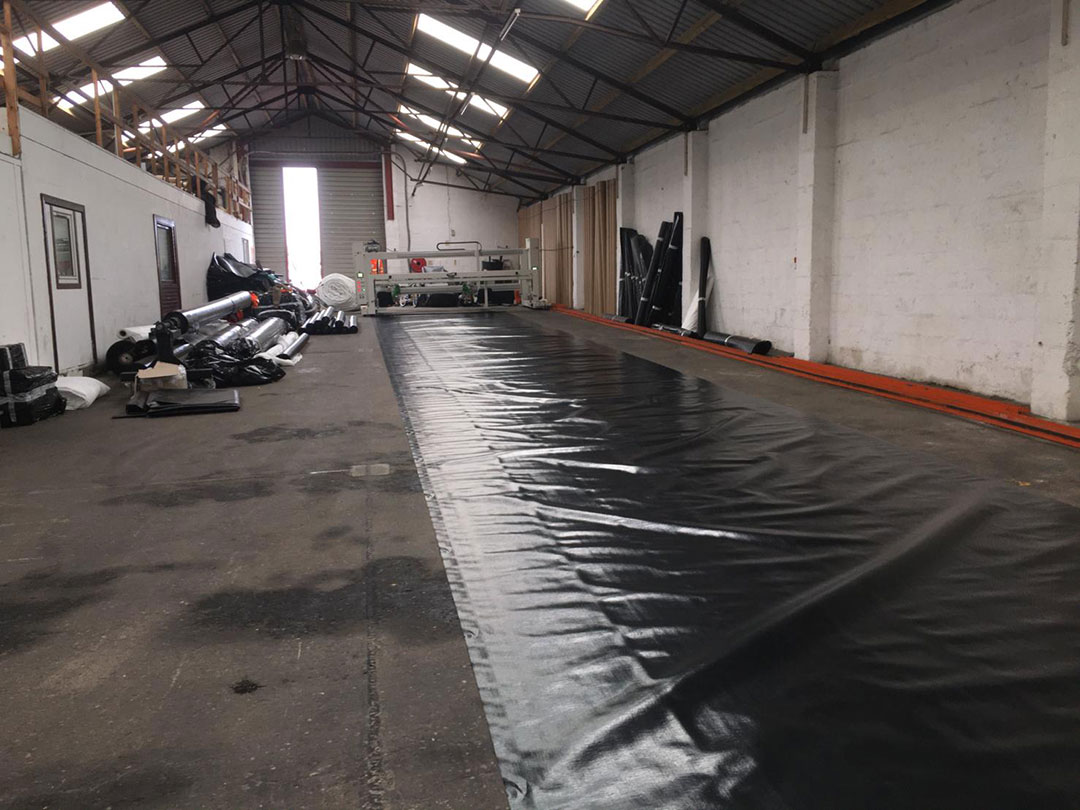
The 112 overlap welder is purpose-built for the thermal joining of geosynthetic materials including HDPE, LLDPE, and woven polypropylene liners. It produces consistent, testable seams at production speeds that generalist equipment cannot reliably match. The Miller Weldmaster 112 Extreme is widely used in GEO liner manufacturing and field installation because it combines precise temperature control, repeatable speed, and reliable seam integrity across demanding applications.
This post breaks down how overlap welding works, what seam characteristics it produces, and exactly why the 112 handles the demands of GEO liner manufacturing.
Key Takeaways: What Sets the 112 Overlap Welder Apart for GEO Applications
- The 112 overlap welder uses a calibrated hot wedge mechanism to fuse geosynthetic materials by melting and pressing two layers together, creating a seam that runs the full length of the liner panel.
- Overlap welding is the dominant field joining method for HDPE and LLDPE geomembranes because it produces dual-track seams that can be pressure-tested for leak detection without cutting the liner.
- The 112 handles material thicknesses from 20 to 80 mil across HDPE, LLDPE, and woven polypropylene, making it adaptable across the range of liner specifications commonly used in GEO projects.
- Seam strength in overlap welding is measured through peel and shear testing, and properly produced HDPE seams can achieve parent material strength.
- GEO manufacturers rely on the 112 for repeatable speed control and consistent temperature management that support production efficiency and field QA compliance.
What Is Overlap Welding? (Definition + Mechanism)
Overlap welding is a thermal welding process used to join two overlapping layers of thermoplastic material by applying heat and pressure simultaneously. In geosynthetic applications, the process is most commonly used for HDPE, LLDPE, and other liner materials where seam integrity and leak prevention are critical.
Unlike extrusion welding, which applies filler material into a joint, overlap welding creates a continuous fused seam directly between two overlapping sheets. The process relies on a hot wedge thermoplastic welding heating element that melts the material surfaces before pressure rollers compress the layers together.
For GEO applications, overlap welding has become the preferred seam method because it produces long, continuous seams that are both strong and testable. The resulting dual-track seam structure includes a center air channel that allows installers to verify seam integrity using non-destructive pressure testing.
The process is widely used across landfill liners, pond containment systems, mining applications, agricultural reservoirs, and industrial secondary containment projects because it balances speed, consistency, and quality assurance, especially when using hot wedge welding for geomembranes and liners.
The Hot Wedge Process — How the Seam Is Made
The welding sequence follows a controlled process:
- Two liner sheets are positioned with a defined overlap.
- The hot wedge heats both material surfaces simultaneously.
- Pressure rollers compress the heated material together.
- A dual-track seam with an enclosed air channel is formed.
The heat generated by the wedge softens the thermoplastic surfaces just enough to allow molecular bonding without degrading the material. Pressure rollers maintain uniform compression while the seam cools and solidifies.
Why Two Tracks Matter — The Test Channel Advantage
The center channel between the two weld tracks is one of the biggest reasons overlap welding dominates geomembrane liner welding applications.
By sealing two parallel weld tracks with an enclosed channel in between, technicians can pressurize the seam using air pressure testing equipment. If pressure loss occurs, the seam contains a void or defect that requires repair.
This allows installers to verify seam integrity without destructive cutting, which is a major advantage over extrusion welding for large-scale liner systems.
| Stage | What Happens | Why It Matters |
|---|---|---|
| Material Overlap Setup | Two sheets are aligned with consistent overlap | Ensures uniform seam width and bonding |
| Hot Wedge Heating | Heated wedge melts both material surfaces | Creates molecular fusion between layers |
| Pressure Roller Fusion | Rollers compress heated materials together | Produces consistent seam strength |
| Dual-Track Seam Formation | Two weld tracks with center channel are formed | Enables non-destructive air pressure testing |
Which GEO Materials Does the 112 Handle?
The 112 overlap welder is designed for thermoplastic geosynthetic materials including HDPE, LLDPE, and woven polypropylene across thicknesses typically ranging from 20 to 80 mil. Different materials require different processing windows, temperature settings, and seam handling characteristics.
Understanding how each material behaves is critical for producing consistent seams that meet project specifications and quality standards. Additional information about geosynthetic material properties and geomembrane containment systems can help manufacturers select the right liner system for their application.
HDPE (High-Density Polyethylene) Liners
HDPE is the most commonly specified geomembrane material for environmental containment applications because of its chemical resistance, durability, and long service life. Typical GEO applications use 40–60 mil HDPE liners, although heavier specifications are common in mining and landfill systems.
HDPE is relatively stiff compared to LLDPE, which affects both handling and welding behavior. It also requires higher processing temperatures to achieve proper fusion. The 112 accommodates these demands with calibrated temperature control and stable pressure application, helping operators maintain seam consistency across long production runs.
LLDPE (Linear Low-Density Polyethylene) Liners
LLDPE liners are more flexible than HDPE and are often selected for projects involving uneven subgrades, complex contours, or applications where elongation performance is important.
Because LLDPE has a lower melt temperature range than HDPE, precise heat control becomes critical. The 112 allows operators to fine-tune temperature and speed settings to avoid overheating or producing brittle seams while still maintaining strong fusion characteristics.
Woven Polypropylene Geotextiles
Woven polypropylene geotextiles are commonly used in filtration, separation, containment, and reinforcement applications. While woven PP behaves differently than smooth geomembrane surfaces, the 112 can still produce effective seams for specialized liner and containment systems.
This capability gives manufacturers flexibility when producing secondary containment structures or integrated geotextile systems that require thermoplastic welding processes rather than sewing.
| Material | Thickness Range | Welding Temp Range | Seam Test Method | Key Application |
|---|---|---|---|---|
| HDPE | 40–80 mil | Higher temperature range | Air pressure + peel/shear testing | Landfills, mining, containment |
| LLDPE | 20–60 mil | Moderate temperature range | Air pressure + peel/shear testing | Reservoirs, ponds, canals |
| Woven PP | Varies by fabric | Lower to moderate range | Visual + mechanical testing | Filtration and containment systems |
Seam Strength in Overlap Welding — What the Numbers Mean
A properly produced overlap seam on HDPE geomembrane must meet seam strength values defined by GRI-GM6 and NSF/ANSI 54 standards. These standards establish minimum acceptable values for both peel strength and shear strength to ensure liner integrity in field applications.
Strong seams are essential because the welded joint must withstand environmental stress, material movement, hydrostatic pressure, and long-term exposure conditions without failure.
Additional information about geomembrane welding standards can help manufacturers and installers understand testing requirements and compliance expectations.
Peel vs. Shear Testing — What Each Measures
- Peel testing pulls the seam apart at a 90-degree angle to evaluate bond integrity between the fused layers.
- Shear testing applies force parallel to the seam to measure structural strength under load conditions.
Most GEO project specifications require both testing methods to validate seam performance.
What “Parent Material Strength” Means for QC
A seam that achieves parent material strength fails within the liner material itself rather than at the welded bond line. This is considered the benchmark for high-quality overlap welding.
For QC teams, achieving parent material strength demonstrates that the seam is no longer the weak point in the system. This level of performance is critical for certified liner installations in environmental and containment projects.
Overlap Welding vs. Extrusion Welding — When Each Method Makes Sense
Overlap welding and extrusion welding are both used in geomembrane fabrication and installation, but they serve different purposes.
Overlap welding uses a hot wedge welding process to fuse overlapping material layers in a continuous pass, while extrusion welding uses melted filler material to bond seams, patches, or detail areas.
Understanding the differences helps manufacturers choose the right process for each stage of production. Additional guidance on liner welding method selection can help evaluate application-specific requirements.
High Performance Overlap Welding Strengths
- Fast continuous seam production
- Dual-track test channel capability
- Ideal for long linear seams
- Preferred for large-area liner installations
- High repeatability across production runs
- Easier non-destructive testing
Extrusion Welding Strengths
- Ideal for corners and detail work
- Effective for repairs and patches
- Handles irregular seam geometry
- Useful for T-joints and penetrations
- Commonly used in field repair situations
| Attribute | Overlap Welding | Extrusion Welding |
|---|---|---|
| Seam Length | Continuous long seams | Shorter localized seams |
| Test Channel | Yes | No |
| Production Speed | High | Lower |
| Ideal Application | Large liner panels | Repairs and detail work |
| Seam Repair Capability | Limited | Excellent |
How the 112 Handles GEO Production Demands
The Miller Weldmaster 112 Extreme is engineered specifically for the demands of geomembrane production and installation. GEO manufacturing environments require consistent heat input, stable speed control, and the flexibility to process multiple material types without extensive downtime.
Unlike general-purpose welding equipment, the 112 is designed around the real production conditions GEO manufacturers face every day.
Temperature Control Across Material Types
Different materials operate within different processing windows. HDPE requires higher heat input than LLDPE, while woven polypropylene introduces its own bonding characteristics.
The 112’s calibrated temperature controls allow operators to adjust settings based on material type and thickness without changing core machine configurations. This flexibility improves uptime while reducing setup complexity.
Speed Consistency, Long Straight Seams, and Production Output
Inconsistent speed creates inconsistent heat exposure, which can lead to seam defects or weak welds. GEO liner production depends on stable travel speed throughout the seam process.
The 112 maintains repeatable drive speed under load, helping operators achieve uniform seam quality across long production runs and varying liner thicknesses while reducing common welding mistakes and defects.
Thickness Tolerance and Setup
The 112 handles geomembrane thicknesses ranging from 20 to 80 mil. Operators can adjust:
- Nip pressure
- Wedge height
- Temperature settings
- Drive speed
These adjustments help optimize the relationship between heat input and material thickness, ensuring proper fusion without overheating or under-welding the liner when using automated welding for geomembranes and geotextiles.
Field and Facility Deployment
The 112 is used in both manufacturing facilities and field installation environments. GEO manufacturers value portability, ease of setup, and reliable operation when moving equipment between jobsites, often alongside custom converting welding equipment tailored to their specific processes.
Before deployment, operators typically verify power requirements, material compatibility, calibration settings, and seam testing procedures to ensure the machine is ready for production. Miller Weldmaster continues to support GEO manufacturers worldwide with application expertise and welding solutions.
Who Uses the 112 — GEO Applications, Erosion Control, and Industry Context
The 112 overlap welder supports a wide range of geomembrane liner manufacturing and containment applications across multiple industries, and it is often complemented by certified used fabric welding machines in cost-sensitive operations.
Common applications include:
- Pond and reservoir liners for agricultural and aquaculture containment
- Stormwater retention systems
- Landfill primary and secondary liner systems, including geosynthetic clay liners used to prevent leachate migration
- Mining heap leach pads and tailings impoundments
- Canal and waterway lining
- Geomembrane floating cover systems
- Industrial spill containment systems
- Secondary containment barriers
- Woven polypropylene geotextile systems
- Filtration and separation layers
These systems can provide a strong hydraulic barrier against fluid migration, and GCLs can self-repair minor punctures because sodium bentonite clay swells significantly when hydrated. They are also lightweight and flexible for easy installation, and geosynthetics can reduce construction time and costs in civil engineering projects.
As demand for environmental containment and infrastructure protection continues to grow, manufacturers increasingly rely on durable welding systems that support repeatable seam quality and efficient production, including specialized solutions for cured-in-place pipeline (CIPP) manufacturing.
Frequently Asked Questions About the 112 Overlap Welder
What is an overlap welder?
An overlap welder is a machine that joins two thermoplastic layers by passing a hot wedge element between them and applying pressure via drive rollers, creating a continuous fused seam. In geosynthetic applications, it produces a dual-track seam structure that includes a center channel for non-destructive air pressure testing. The method is the standard for large-area liner installation because it is fast, repeatable, and testable without cutting the liner.
What materials can the 112 overlap welder weld?
The 112 is designed for thermoplastic geosynthetic materials including HDPE (high-density polyethylene), LLDPE (linear low-density polyethylene), and woven polypropylene. It handles material thicknesses from 20 to 80 mil, covering the range used in most GEO liner specifications. The temperature and speed settings are adjusted based on material type and thickness.
What is the difference between overlap welding and extrusion welding for geomembranes?
Overlap welding uses a hot wedge to fuse two overlapping layers in a single pass, producing a continuous dual-track seam suited to large liner panels. Extrusion welding melts a bead of filler material into a joint and is preferred for patches, corners, and complex geometry. For production-scale liner installation, overlap welding is faster and produces a built-in test channel, while extrusion welding is better for detail work and repairs.
How do you test geosynthetic overlap welds?
Geosynthetic overlap welds are tested using two methods. Non-destructive testing involves pressurizing the air channel between the two weld tracks and monitoring for pressure loss, which indicates a void or incomplete bond. Destructive testing involves cutting seam samples and performing peel and shear tests per GRI-GM6 or project specifications to confirm the seam meets strength requirements.
What seam strength should an HDPE overlap weld achieve?
Per GRI-GM6, HDPE overlap seams must achieve minimum shear strength values based on parent material performance. Properly produced seams should exhibit failure in the parent material rather than at the bond line. Peel strength minimums must also be met to satisfy project QC requirements.
Can one overlap welder handle both HDPE and LLDPE without reconfiguring?
Yes, but temperature and speed settings must be adjusted. LLDPE operates within a lower melt temperature range than HDPE, so using HDPE settings on LLDPE can damage the material or create brittle seams. The 112’s adjustable controls allow operators to optimize settings for each material type while maintaining consistent seam quality.
Final Thoughts
For GEO liner manufacturers and installers, welding consistency directly impacts seam quality, project compliance, and long-term containment performance. The 112 overlap welder combines calibrated heat control, repeatable speed management, and proven dual-track seam technology to support the demanding requirements of geomembrane production.
Whether working with HDPE, LLDPE, or woven polypropylene systems, the 112 delivers the seam quality and production capability required for modern containment applications.
To learn more about the 112 Extreme overlap welder or discuss your specific GEO application, talk to a Weldmaster applications specialist.