Sign shops often ask the same question before upgrading their finishing department: Is a banner welding machine actually worth the investment? With rising material costs and tight production timelines, the comparison between hem tape, sewing, and welding comes down to one thing—ROI. Whether you're competing on turnaround time, reducing rework, or trying to eliminate consumable waste, understanding the banner welding machine ROI can clarify when the upgrade becomes financially smart.
Evaluating the total investment cost—including initial capital expenditure and total cost of ownership—is a critical step in determining if a banner welding machine is a profitable investment. Initial Capital Expenditure (CapEx) for an automated welding system includes hardware, software, integration, workholding, safety infrastructure, and ancillary equipment costs.
If your business produces banners, flags, displays, or soft signage, welding can dramatically streamline your finishing workflow. Many shops in the sign and banner industry are already shifting away from tape and sewing due to durability issues, labor inefficiencies, and unnecessary rework. Understanding the investment's profitability requires looking beyond just the price to include all associated costs and long-term financial benefits.
In this guide:
- How to calculate banner welding machine ROI
- Tape vs. sewing vs. welding
- Where shops save the most
- How welding changes your workflow
- Payback examples for small and mid-size shops
- Questions buyers ask before switching
- Why welded edges hold up better
- Choosing the right banner welder
- Miller Weldmaster banner welders by shop size
- Quality control checklist
- Frequently asked questions
How to Calculate Banner Welding Machine ROI for a Sign Shop
A thorough ROI calculation should also consider advanced financial metrics such as net present value (NPV), internal rate of return (IRR), and the time value of money to provide a more accurate assessment of investment profitability. Net Present Value (NPV) accounts for the time value of money and is used to evaluate the profitability of equipment investments.
Calculating ROI requires only a few core inputs:
- Initial investment cost
- Expected annual savings or additional revenue
- Estimated useful life of the equipment
Analyzing cash flow and conducting sensitivity analysis can help shops understand how changes in key variables impact the investment's profitability and the robustness of the ROI calculation.
ROI Formula
ROI = (Annual Finishing Savings – Machine Cost) ÷ Machine Cost
Input Variables
-
Machine cost: upfront investment
-
Labor rate per hour
-
Banners produced per week
-
Current finishing time (tape or sewing)
-
Consumable spend: hem tape rolls, sewing thread, needles
-
Rework/returns due to failures
Output Variables
-
Minutes saved per banner
-
Total weekly labor hours saved
-
Fewer failed hems → fewer remakes
-
Better warranty reliability → fewer customer returns
Example Payback Scenarios
Small shop (50 banners/week):
-
Saves ~2–3 minutes per banner
-
Labor rate: $20/hr
-
Annual savings: ~$3,500–$5,000
-
Payback period: 9–14 months
Mid-size shop (150 banners/week):
-
Saves ~4–5 minutes per banner
-
Annual savings: $15,000–$22,000
-
Payback period: 4–8 months
Tape vs Sewing vs Welding: What’s Faster and What Fails Less?
Choosing the right finishing method impacts speed, durability, and customer satisfaction. Traditional manual processes like manual welding are labor-intensive and rely heavily on skilled welders, which can lead to variability in weld quality.
Automation equipment enables the production of precise welds and high quality welds, improving consistency and reducing human error compared to manual welding. This results in better weld quality and supports skilled welders by allowing them to focus on more complex tasks.
Speed Comparison
-
Hem tape: 6-10 minutes per banner (handling backing, trimming edges)
-
Sewing: 4–7 minutes per banner, depending on run length
-
Welding: 1–3 minutes per banner, consistent across batch sizes
Failure Rate Comparison
| Method | Common Failure Points |
|---|---|
| Hem Tape | Adhesive creep in heat, peeling edges, failed corners |
| Sewing | Needle holes, thread degradation, inconsistent stitch tension |
| Welding | Consistent fused hem; few weak points when operator settings are correct |
Pros & Cons Snapshot
Hem Tape
✔ Easy for beginners
✘ Frequent edge failures, costly consumables
Sewing
✔ Strong when executed well
✘ Slow, inconsistent, requires skilled labor
Welding
✔ Fastest and most durable
✘ Requires upfront investment
Read the full comparison here: Comparison of banner welding versus sewing methods
Where Shops Save the Most: Labor Costs, Consumables, and Zero Tape Waste
Tape-based finishing hides many labor drains. Removing liner backing, peeling, trimming, alignment, and cleanup all add minutes per banner. Switching to welding leads to significant cost savings by reducing material waste and operational costs.
Key savings include less manual labor, fewer errors, and faster turnaround. Improved operational efficiency and increased production capacity allow shops to enhance productivity and better meet customer demand.
Ongoing maintenance is minimal compared to the recurring costs of consumables in other methods.
Key Savings with Welding
-
No tape handling or waste
-
No thread or needle purchases
-
Cleaner production workspace
-
Fewer reprints due to edge failures
-
Reduced returns and warranty issues
- Reduced material waste due to improved precision and consistency
Consumable Cost Comparison (Estimates)
| Method | Annual Consumable Spend |
|---|---|
| Hem Tape | $3,000–$10,000+ depending on volume |
| Sewing | $300–$800 |
| Welding | $0 (no consumables) |
How Banner Welding Changes Your Finishing Workflow
Switching to welding reshapes your finishing line for speed and consistency.
Tape Workflow
-
Measure and align tape
-
Apply tape along hem
-
Remove tape liner
-
Fold hem and press
-
Trim excess
Welding Workflow
-
Load banner edge
-
Align material
-
Apply welded hem in one pass
-
Move to grommeting or finishing
The shift eliminates several bottlenecks. For edge-specific welding, see the T300 Extreme Edge.
Example: What Payback Period Looks Like for Small vs Mid-Size Sign Shops
Small Shop (30–70 banners/week)
-
Saves 1–2 hours of labor weekly
-
Eliminates tape cost
-
Prevents 2–4 rework banners/month
Estimated payback: 8–14 months
Mid-Size Shop (100–300 banners/week)
-
Saves 4–7 hours of labor weekly
-
Eliminates a significant tape budget
-
Dramatic drop in reprints and returns
Estimated payback: 4–8 months
To compare a monthly machine payment with your monthly savings, try the Miller Weldmaster machine financing calculator.
Micro Q&A: Questions Buyers Ask Before Switching to Welding
What training is needed to run a banner welder?
Operators can learn alignment, speed, and pressure basics in a few hours. Most shops are fully comfortable within a day.
How fast is setup compared to tape?
Warm-up is brief, and alignment takes seconds. Tape reloads, liner removal, and thread tension adjustments take considerably longer.
Does welding improve warranty reliability?
Yes. Welded hems eliminate adhesive creep and thread failure, reducing returns tied to peeling or corner separation.
Can welded banners still be grommeted?
Absolutely. Use standard spacing and ensure reinforced corners when needed.
What if my shop takes custom one-offs?
Welding excels at both small runs and large batch production.
Banner Durability: Why Welded Edges Hold Up Better Under Load
Welded edges maintain stronger hem integrity under tension, wind load, and outdoor elements. Automated welding systems and welding automation ensure consistent weld quality and improved product quality by precisely controlling welding parameters and the welding path, resulting in reliable, high-performance banners. Welding creates a permanent bond that is significantly stronger than sewn or taped seams, enhancing durability and resistance to environmental factors. Tape fails when adhesive softens, and sewing introduces perforations that can expand under stress.
Applications benefiting from welded hems include:
-
Mesh banners on fences
-
Street pole banners
-
Truck-side and vehicle-mounted banners
-
Large-format building wraps
These quality improvements are a direct result of using advanced welding processes and automated welding equipment, which deliver improved quality, consistency, and durability for demanding applications.
Read more about enhancing banner welding strength and speed with the T300 Extreme Edge: T300 Edge Banner Welding: Stronger, Faster
Choosing the Right Banner Welder for Your Shop’s Size and Budget
Small Shops:
Look for entry-level machines with simple controls, ideal for 10–70 banners per week.
Mid-Size Shops:
Choose mid-range welders with automation options for consistent production.
Large Shops or High Volume:
Consider advanced multi-function welders with programmable settings and automation.
What affects cost?
-
Heating technology
-
Weld throat size
-
Automation level
-
Digital controls and repeatability features
Hot Air, Hot Wedge, or RF: Which Banner Welder Fits?
Start with the heating technology. Hot air welders are the most versatile: they work with many banner materials and seam types, including printed graphics that must line up exactly. Hot wedge welders run long, straight hems at high speed with very consistent results. Radio frequency (RF) welders bond PVC and PU banner materials, and custom dies let them weld shapes as well as straight seams.
What to Weigh Before You Buy
- Materials: Make sure the welder handles the banner stock you run most, such as PVC vinyl, mesh or PE. Heavier, thicker materials need more welding power than light fabrics.
- Banner size and volume: Long graphics and billboards need tables, a vacuum track or automated material handling. Small banners and short runs fit a compact tabletop welder.
- Budget: Weigh the price against the payback math above. A more capable welder costs more up front but can pay back sooner when it takes more labor out of each banner.
Miller Weldmaster Banner Welders by Shop Size
Here is how Miller Weldmaster’s current banner welders match the shop sizes above:
- T3 Extreme for small shops: a compact tabletop hot wedge welder designed for smaller businesses. It makes the hems, pole pockets and webbing seams a banner and sign maker needs, on a solid steel frame.
- T300 Extreme Edge for fast banner finishing: our fastest welder for finishing banners and signs. It finishes a 4 x 6 banner in under a minute, comes in hot air, hot wedge or both, and stores 25 settings for quick recall.
- RFlex for RF welding: our most versatile radio frequency welder, for PVC and PU signs and billboards. It has a large foldable worktable with a deep trough for material handling and stores 100 weld recipes.
- 112 Extreme for large graphics and billboards: a hot air welder built to the length you need, with a vacuum track and laser lights that keep printed images aligned, a rotary cutter for cut-to-length work and an optional grommet machine.
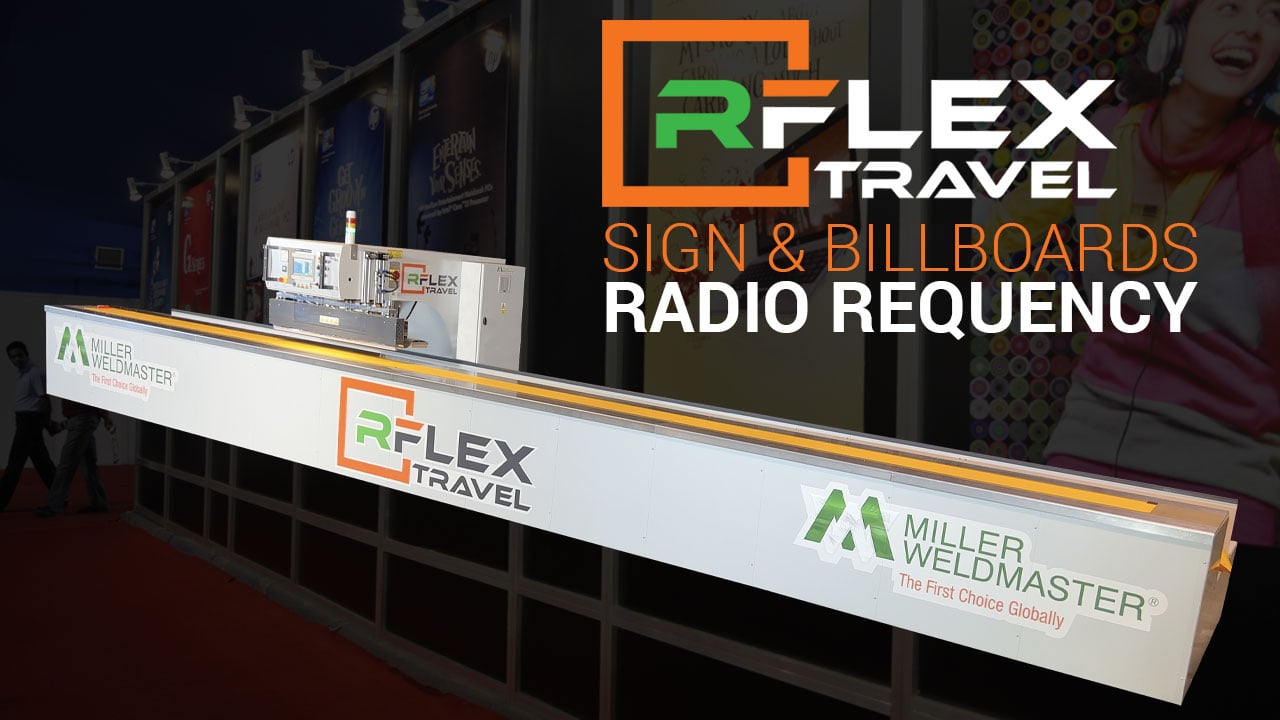
- RFlex Travel for oversized RF jobs: line the material up with the lasers on the track and the RF head travels along it, on work tables up to 100 m long.
- Automated systems for high volume: the DH7600 Double Hemmer finishes both outside edges of a banner at the same time, and the Ecco Sheet System finishes all four sides of a single-sheet poster board in 2 minutes or less.
Not sure which welder fits your volume? Talk to a Miller Weldmaster expert, or send us a sample and we’ll test it on our machines.
Quality Control Checklist for Welded Banners
A solid QC process protects your profits and reduces returns. Effective process control and the integration of safety systems are essential for maintaining high quality standards in automated welding environments.
Optimizing floor space is also important for efficient workflow and quality control.
QC Items
-
Confirm straight edge alignment
-
Check temperature and speed settings
-
Inspect weld bond clarity
-
Ensure clean, debris-free material
-
Validate hem width and consistency
Common mistakes to avoid:
-
Overheating material
-
Running too fast, resulting in weak bonds
-
Welding contaminated or dusty surfaces
Conclusion: How Welding Strengthens Profit Margins and Production Flow
A banner welding machine enhances both speed and durability, reducing consumable spend, preventing rework, and offering faster turnaround times. Investing in welding automation and automated welding provides a competitive advantage by delivering cost savings, operational efficiency, and increased production capacity, making it a profitable investment for sign shops. For many shops, the ROI is measured in months—not years. Businesses often see a payback period of 6 to 24 months for a banner welding machine. By running real numbers rather than assumptions, you’ll quickly see where welding pays off.
Miller Weldmaster supports sign shops worldwide with equipment, onboarding, and workflow guidance to ensure a seamless transition from tape or sewing to welding. For deeper exploration, visit our sign/banner industry hub.
Related Guides
- Double hem banner welding with the DH7600
- Welding large-format signs and banners
- When hot wedge beats hot air for signs
- Keder edges for signs and structures
- Traveling welder for banners and signs
Frequently Asked Questions About Banner Welding Machine ROI
Does welding always beat tape on long-term cost?
Tape may still be useful for temporary installs or extremely low-volume work. However, for ongoing banner production, welding nearly always delivers lower costs and higher durability.
How long does a banner welder typically last?
Most industrial welders last many years with regular maintenance and proper operating conditions.
What fabric types weld best for banners?
PVC banner stock, scrim vinyl, mesh, and blockout materials weld extremely well. Poly-based materials may require specific settings depending on composition.
How much space does a banner welder require?
Small welders fit into modest finishing areas; automated systems require additional clearance for material handling and operator movement.
Will welding change my grommet workflow?
The workflow stays the same, but your hems will be stronger and more consistent, improving overall grommet hold strength.