This ultimate guide to tarpaulin welding machines covers everything you need to know about welding tarps, including the right process, material understanding, and equipment. In this tarpaulin welding machine guide, we break down the steps for welding PVC and polyethylene (PE) tarps, how to build strong hems and webbing, and what to know about QC testing and long-run automation. Tarpaulin welding machines are used across various industries for outdoor structures such as tents, banners, and awnings, where waterproof and durable seams are essential. A key focus of this guide is PVC tarpaulin welding, highlighting specialized equipment and techniques for creating strong, weatherproof joins on outdoor PVC fabric structures. Selecting a tarpaulin welding machine based on material compatibility, power supply, and production needs is crucial for achieving optimal results. If you manufacture truck tarps, agricultural covers, construction tarps, container tops, or large industrial panels, this guide gives you the foundation for cleaner, longer-lasting seams.
For industry-specific insights, visit our page on tarpaulins and tarp production:
https://www.weldmaster.com/industries/tarpaulins-and-tarps
Why Weld Tarpaulins Instead of Sewing? (Tarp Welding vs Sewing Durability)
Sewing punctures the material with a needle and thread, while welding fuses thermoplastic layers into a single continuous piece. The difference in durability is significant.
Why welded seams outperform stitched seams:
-
No needle holes → stronger waterproofing
-
Higher seam strength → fused material performs closer to base fabric strength
- Continous weld → seamless, uniform join for maximum reliability
-
Better longevity → no thread degradation
-
Improved appearance → clean, uniform finish
When sewing still makes sense:
-
Light-duty tarps
-
Situations where the material isn’t weldable
-
When adding accessories like grommet reinforcement
But for heavy-duty truck tarps, industrial covers, and long-lasting fabric structures, welding consistently delivers a far more durable result. The welding process forms a durable bond that enhances the longevity and performance of the tarpaulin. Welding quality is a critical factor in ensuring the long-term durability of tarpaulin seams.
Material Basics: PVC vs PE Tarpaulins and Their Weldability
PVC (Polyvinyl Chloride) Tarps
- Made from durable PVC material, providing excellent weldability and superior weather resistance
-
Heavy-duty and long-lasting
-
Excellent weldability
-
High flexibility, good cold-weather performance
-
Typical weights: 400–900 g/m²
PE (Polyethylene) Tarps
-
Lightweight and economical
-
Lower melt-flow index
-
More challenging to weld
-
Cold brittleness possible depending on grade
Weldability Summary:
-
PVC: Fuses easily with hot air, hot wedge, or HF welding.
-
PE: Requires more precise temperature control and may not weld consistently depending on formulation.
PVC is typically chosen for industrial and high-stress applications, while PE is common for budget tarps.
Can You Weld PE Tarps? (Polyethylene Tarp Welding Methods)
Yes—PE can be welded, but it requires a narrow temperature window and careful parameter control. Selecting the correct temperature range is critical for welding PE tarps to ensure proper seam strength and quality.
Why PE is challenging:
-
Lower melting point → easier to overheat
-
Less surface adhesion
-
More variation between PE formulations
Methods used for welding PE tarps:
-
Hot air welding with careful temperature reduction (this method is also commonly used to weld PVC and weld PVC tarpaulin)
-
Hot wedge welding with reduced speed
-
Impulse welding for precision sealing
Precise heating during the welding process is essential to avoid damaging the material and to ensure a durable bond. The overall welding process for PE tarps involves controlled heating, applying pressure, and managing movement to achieve a consistent, high-quality seam.
Tip: Test PE welding on scrap from the same batch. Even slight formulation differences affect weldability. Achieving strong welds requires careful process control and attention to each step of the welding process.
Step-by-Step Seam Creation for Large Panels: From Cut to Finished Weld
Use this process to build strong, consistent large panels. Using the right welding equipment is essential for achieving consistent results and high-quality seams.
Machine Setup
Set up your hot air welding machine according to the manufacturer's instructions. Adjust the air volume to ensure the correct amount of heated air is delivered during the welding process. Make sure the pressure rollers are properly aligned and functioning, as they apply consistent force to bond the materials effectively. Maintaining the correct temperature of the heated air is crucial for proper fusion of the thermoplastic materials. Before operating the machine, check the power cord, nozzle, weld roller, and guides for any damage or debris.
Welding Pass
During the welding pass, direct the heated air precisely at the welding area to melt and fuse the materials. The process uses heated air at controlled temperatures and does not require direct contact with the material, reducing the risk of surface damage. Move the machine steadily along the seam to ensure even bonding.
Post-Weld Finishing
After welding, allow the seam to cool. Inspect the seam carefully for any weak spots, such as bubbles or missed welds, to ensure seam integrity and durability. Trim any excess material as needed.
1. Material Preparation
-
Clean surfaces
-
Square your cuts
-
Plan extra material for hems or overlaps
2. Edge Hem & Webbing Integration
-
Fold edges 1–2 inches
-
Insert webbing for reinforcement
-
Pre-tack to hold position
3. Reinforcement Patches (Corners & Stress Points)
-
Add patches on truck tarp corners, tie-down areas
-
Use pre-cut templates for consistency
4. Overlap Setup
-
Standard overlap: 1.5–2 inches
-
Consistent width is critical for seam strength
5. Machine Setup
-
Set temperature, speed, pressure
-
Adjust for material: PVC needs more heat; PE requires lower heat and slower speed
6. Welding Pass
-
Keep material flat
-
Maintain steady feed
-
Avoid wrinkles or trapped air
7. Post-Weld Finishing
-
Trim excess
-
Clean debris
-
Allow full cooling before tensioning
8. Final QC Inspection
-
Check seam uniformity
-
Perform peel test
-
Verify waterproofing
For more fabrication insight, see:
https://www.weldmaster.com/blog/mastering-tarp-heat-sealing-and-stitching-tips
Welding Parameters for Thick Tarps – What to Set and Why
Thicker materials require stronger welds and tighter control. Proper weld setup is essential for the long-term durability of tarpaulins, ensuring strong, waterproof seams that withstand harsh conditions.
Key definitions:
-
Edge hem: Folded edge for strength
-
Webbing: Reinforcement strap welded or sewn into hem
-
Corner patch: Extra piece welded at high-stress corners
Weld setup recommendations:
-
Increase pressure for thick hems
-
Reduce speed when welding webbing
-
Multiple weld passes for corner patches
-
Use greater overlap when combining thick layers
-
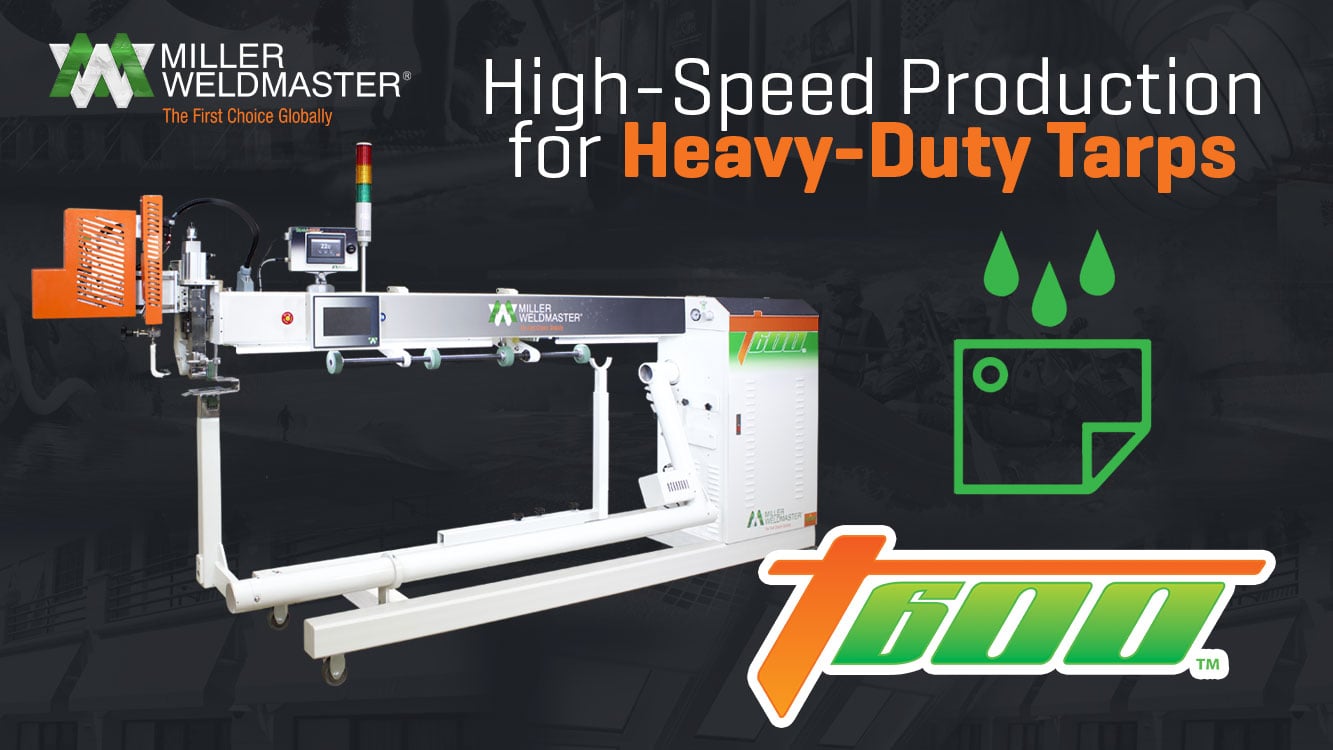
For thick tarps and industrial fabrics, use a hot air welding machine to achieve consistent, high-quality seams
These welding parameters are also critical when working with roofing membranes, which require durable, waterproof bonds for long-lasting performance in construction and renovation projects.
Weak reinforcement areas are the most common cause of tarp failure, especially on truck covers and cargo containment systems.
Large Panel Welding Automation – Equipment Paths & Production Efficiency
Large tarpaulins often measure 10–30 ft wide and 50+ ft long, requiring specialized equipment.
Automation options include:
-
Long-arm hot air or hot wedge welders
-
Hot air welding machines for industrial fabric welding
-
High frequency welding machines (HF) utilizing electromagnetic waves for thermoplastic bonding
-
Traveling head welders
-
Automated cover production lines
-
HF or impulse systems with large tables
Portable manual or semi-automated machines may be sufficient for low volume or occasional use, while high-volume operations require automated systems or machines with a high duty cycle.
Automation delivers:
-
Higher throughput
-
Fewer operator errors
-
Consistent seam width and strength
-
Lower labor cost
-
Significant scrap reduction
To ensure optimal performance and minimize downtime, regular maintenance and the availability of spare parts for hot air welding machines and high frequency welding machines are essential. When scaling up production, placing bulk orders for welding equipment can provide benefits such as OEM customization, faster shipping, and extended warranties.
Learn more about automated systems:
https://www.weldmaster.com/automated-covers-tarpaulin
Quality Control & Waterproof Tarpaulin Seam Testing
Strong seams require measurable QC.
Recommended QC tests:
-
Peel & tensile test: Ensure seam strength ≥ 80% of base fabric
-
Burst or leak test: Pressure or spray water for X minutes
-
Visual/ultrasonic inspection: Check for non-fusion or bubbles
-
Waterproof test: Confirm no seepage along seam
QC Checklist Example:
-
Weld parameters recorded
-
Operator initials
-
Material batch #
-
Seam inspected and signed off
For reinforcement best practices, explore:
https://www.weldmaster.com/blog/tarp-reinforcement-techniques
Maintenance & Best Practices for Tarpaulin Welders
Reliable seams depend on reliable machines. Regular maintenance of your hot air welding equipment is essential for reliable performance and high-quality results.
Daily tasks:
-
Clean nozzles
-
Inspect rollers
-
Remove debris
Weekly tasks:
-
Check temperature accuracy
-
Inspect wedge/hot air nozzle
Annual maintenance:
-
Full calibration
-
Replace worn rollers and heaters
Operator best practices:
-
Learn correct feed technique
-
Maintain flat panel alignment
-
Watch for early signs of seam failure
-
Use portable hot air welders for on site repairs and maintenance, especially in field conditions where mobility is crucial
-
Hot air welders are essential for quick repairs in emergency shelters and other demanding field applications
-
Regular maintenance and operator training are essential for optimal performance of hot air welding machines.
Miller Weldmaster supports manufacturers with training, parts, and global field services:
https://www.weldmaster.com/contact-us
Method Comparison Chart: PVC vs PE Welding
| Material | Common Methods | Typical Parameters | Seam Strength | Challenges |
|---|---|---|---|---|
| PVC |
Hot air, wedge, HF (radio frequency, high frequency electromagnetic waves/field), ultrasonic welding |
300–600°C (method dependent) | ~70–95% of base fabric | Heavy, plasticizer aging |
| PE | Hot air, wedge, impulse | Lower temperature window | ~50–80% of base fabric | Cold brittleness, inconsistent formulation |
Note: HF welding (also known as radio frequency welding) uses a high frequency electromagnetic field to generate heat within thermoplastic materials, such as PVC, resulting in strong, durable seams. The process relies on high frequency electromagnetic waves to generate heat internally, creating airtight and watertight bonds. In contrast, ultrasonic welding uses high-frequency vibrations to generate heat at the joint, making it suitable for thin or delicate materials. Other methods like hot air and hot wedge welding generate heat externally and are versatile for various industrial fabric joining techniques. High-frequency welding is particularly effective for creating airtight and watertight seals in thermoplastic materials.
Key takeaways:
-
PVC = best for heavy-duty tarps
-
PE = lighter, economical, but harder to weld reliably
-
HF welding often produces the strongest PVC seams compared to ultrasonic welding and other methods, due to its ability to generate heat internally and create robust, sealed joints.
See more equipment options:
https://www.weldmaster.com/machine-overview
Conclusion: Bringing It All Together for Stronger, Longer-Lasting Tarps
Producing durable welded tarpaulins relies on:
-
Proper material understanding (PVC vs PE)
-
Correct weld parameters
-
Reinforcement strategies
-
Seam testing
-
Machine maintenance
Large tarp production also demands careful panel handling and consistent machine control. With decades of global experience, Miller Weldmaster continues to support tarp manufacturers in building stronger, longer-lasting welded covers.
Frequently Asked Questions About Welding Heavy-Duty Tarpaulins
What is the most durable method for welding heavy-duty tarpaulins?
For industrial truck tarps and container covers, hot air, hot wedge, or high-frequency welding are common. HF typically offers the strongest bond on PVC.
How wide should the weld seam be for a heavy truck tarp?
A typical overlap is 1.5–2 inches (38–50 mm) depending on your machine and material thickness.
What thickness of material can standard tarpaulin welding machines handle?
PVC tarps up to ~900 g/m² (≈1.0–1.2 mm) are commonly welded. PE varies more and may require testing.
How do you test a welded seam to ensure waterproof integrity?
Perform a peel test, tensile test, visual weld scan, and a pressurized water spray or immersion test.