The first time a shop takes on a billboard panel or building wrap, things can go sideways quickly—panels drift, seams misalign, and what should have been a straightforward job turns into a costly remake. A sign welding machine for large format applications isn’t just a bigger version of a standard welder—it’s a completely different production solution.
A large format sign welding machine is industrial equipment designed to weld oversized vinyl, mesh, or PVC panels while maintaining material control, consistent pressure, and repeatable seams across long runs. Standard finishing setups—built for smaller banners—simply aren’t designed to handle these challenges at scale.
For shops working with sign and banner welding equipment, understanding these differences is the first step toward improving production efficiency and quality.
Key Takeaways
- Large format welding requires control of material handling, pressure, and repeatability—not just heat.
- Seam issues on oversized panels are typically equipment-related, not operator error.
- Traveling-head machines reduce handling risks and improve alignment.
- The right solution depends on panel size, materials, and production volume.
- Standard workflows often break down at billboard and building wrap scale.
What Large-Format Sign Production Demands From a Machine
When banners exceed standard dimensions, production challenges multiply. The three biggest issues—material handling, pressure consistency, and seam repeatability—become unavoidable.
Material Handling Across Long Runs
Feeding 10+ feet of vinyl or mesh through a fixed welding station creates immediate risk. As panel size increases, so does the likelihood of:
- Material stretching under its own weight
- Panels drifting out of alignment mid-weld
- Increased labor requirements for staging and handling
These issues are commonly reported by operators working on large prints, where tension changes across long runs. A stationary-material, traveling-head design solves this by keeping the panel flat while the machine moves, dramatically reducing handling errors.
Consistent Pressure Across a Wide Welding Head
As welding heads become wider, maintaining even pressure becomes more difficult. Inconsistent pressure leads to:
- Weak seams at the edges
- Bubbling or uneven welds
- Reduced durability over time compared with welding instead of stitching
Proper pressure helps banner welders create strong, seamless joins without stitching. A properly welded seam is 100% waterproof for outdoor banners, helps protect against damage by avoiding needle holes, and leaves a smooth, clean finish to create strong, durable results.
This isn’t a minor issue—it directly impacts product quality and lifespan, especially for outdoor signage.
Seam Repeatability at Volume
Large-format production often involves repeating the same weld across multiple panels. Without consistent settings, shops face:
- Visible differences between panels
- Increased scrap and rework
- Lost time and material costs
Machines with digital recipe storage and repeatable settings eliminate this variability by standardizing the process and improving speed in volume work, since welded seams are faster to produce than sewn seams.
Production Challenges vs Machine Requirements
| Production Symptom | Underlying Machine Requirement |
|---|---|
| Panels shifting mid-weld | Stationary material / traveling head design |
| Weak or bubbled edges | Consistent pressure control |
| Panel inconsistency | Repeatable weld settings |
| Excess staging space | Reduced material handling footprint |
RF Welding vs. Hot Air Welding for Large-Format Signs
Choosing the right welding method depends on application, durability needs, and production scale.
When RF Welding Makes Sense for Oversized Work
RF welding fuses material from the inside out, creating a strong, hermetic seam ideal for:
- Billboards
- Building wraps
- Architectural graphics
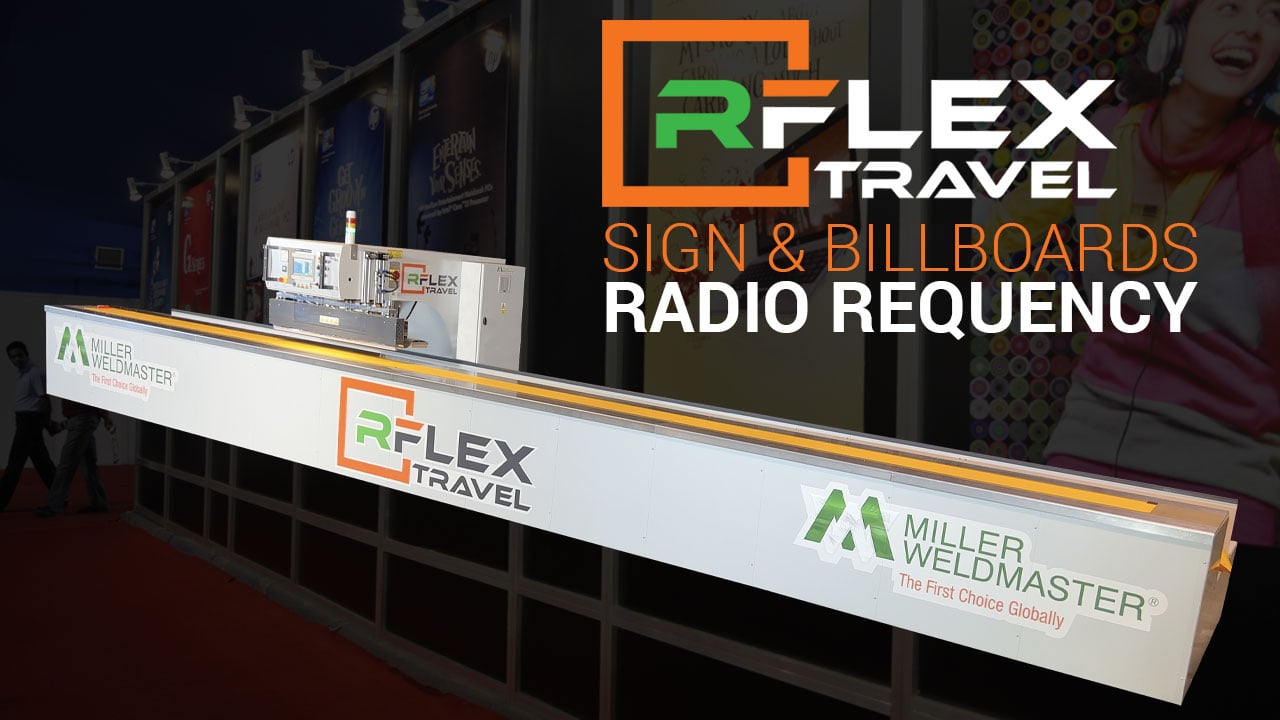
A traveling-head RF system—like an RF welder built for large-format panels—keeps material stationary, solving major alignment challenges.
When Hot Air Welding Is Still the Right Call
Hot air welding uses high-temperature air to bond materials, making this welding process a practical solution for:
- Standard banner production
- Smaller large-format jobs
- Cost-sensitive applications
It offers flexibility and efficiency when extreme durability isn’t required.
Welding Method Comparison
| Method | Best For | Seam Characteristics | Large-Format Consideration |
|---|---|---|---|
| RF Welding | Billboards, wraps | Strong, weatherproof | Ideal for long-term durability |
| Hot Air Welding | General banners | Flexible, consistent | Good for medium-scale jobs |
| Hot Wedge Welding | Heavy materials | Strong seams | Useful for specific applications |
Evaluating Your Current Finishing Setup Against Large-Format Requirements
Many shops don’t realize their equipment is the bottleneck until problems appear. Use this checklist:
- Compare your panel sizes to your machine’s capabilities
- Track rework rates on oversized jobs
- Identify labor-heavy handling steps
- Check for repeatable machine settings
- Confirm compatibility with your materials
A properly welded seam also improves durability—which is why why welded seams outperform sewn ones is a critical consideration.
Core Machine Features to Look for in Large-Format Sign Welding Equipment
Welding Head Width and Worktable Length
Your machine should match your largest realistic job, not your average; for heavy large-format work, look for sustained high-amperage output, typically 300 to 500 amps, because large-format projects require sustained high-amperage output, and a 60% to 100% duty cycle supports continuous operation without overheating for reliable performance and high performance on demanding jobs.
Traveling-Head vs. Fixed-Station Design
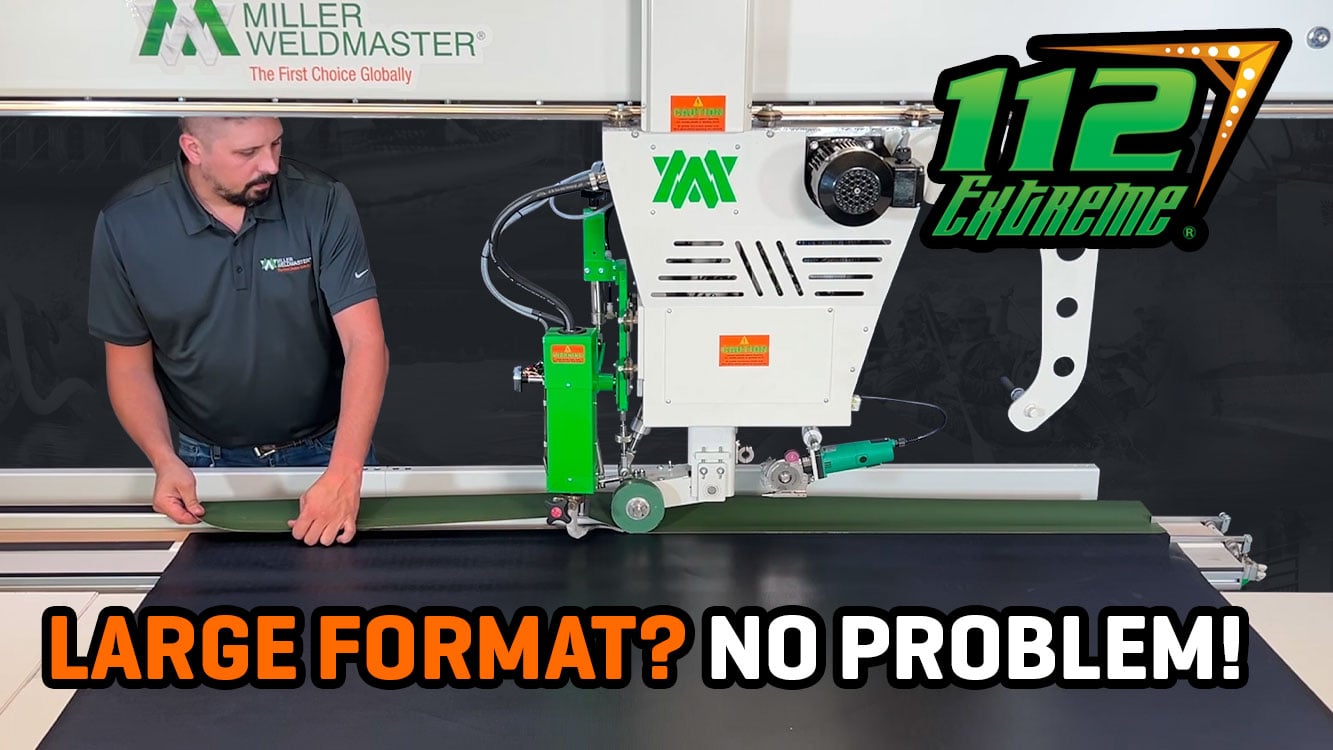
Traveling-head machines reduce handling issues and improve seam accuracy. Solutions like the 112 Extreme for long, straight seams are built specifically for high-volume, long-run applications.
Recallable, Repeatable Weld Settings
Digital controls allow operators to maintain consistent results across jobs.
Material Compatibility Range
Ensure compatibility with:
- PVC
- Mesh
- Coated fabrics
For example, large-format welding equipment comes in handheld, tabletop, and automated roll-fed types depending on the materials and workflow.
Feature Checklist
| Feature | Why It Matters | Questions to Ask |
|---|---|---|
| Head width | Matches panel size | Does it fit your largest job? |
| Traveling head | Reduces handling | Does material stay stationary? |
| Digital controls | Ensures consistency | Can you save settings? |
| Material compatibility | Prevents failures | Does it handle your materials? |
How Miller Weldmaster Supports Large-Format Sign and Banner Production
As shops grow into oversized production, standard equipment often becomes the limiting factor, which is why Miller Weldmaster serves the sign industry with systems built for large-format banner production.
Miller Weldmaster offers:
- Traveling-head RF and hot air systems
- High-speed straight seam welders
- Advanced finishing solutions like double hem welding for banner wedges and reinforced edges
These solutions are designed to scale with production demands while maintaining quality and efficiency.
If you’re exploring large-format capabilities, working with an experienced application specialist can help customers identify the right system for their operation.
Frequently Asked Questions About Large Format Sign Welding Machines
What is a large format sign and banner welding machine?
A large format sign welding machine is industrial equipment designed to weld oversized vinyl, mesh, or PVC panels while maintaining consistent pressure and alignment across long seams to create durable large-format signs and banners. It helps shops produce clean, reliable seam quality on oversized graphics and display materials.
Why do large banners have seam consistency problems?
Seam issues often result from equipment limitations. Larger panels introduce alignment and pressure challenges that standard machines aren’t built to handle.
RF welding vs. hot air welding — which is better?
RF welding is ideal for durability and outdoor use, while hot air welding is more cost-effective for general production.
What should I look for in a welding machine?
Focus on head width, traveling-head design, repeatable settings, and material compatibility. For larger industrial operations, also look for multi-process capability, three-phase power where required at most industrial sites, heavy-duty wiring and cooling systems for sustained high-amperage output, and updated technology that improves consistency and efficiency.
Can portable welders handle large format work?
They are best used for supplemental tasks, not primary production of billboard-scale panels.
How do I know if my equipment is limiting production?
Signs include increased rework, alignment issues, and higher labor requirements on large jobs.