When a banner or building wrap is too large to move across a traditional welding table, production doesn’t just slow down—it can stop entirely. A traveling welder for banners and signs solves this by keeping the material stationary while the welding head moves across it, allowing manufacturers to handle oversized panels with precision and consistency. This approach is built into modern sign and banner welding machine solutions, enabling shops to take on billboard faces, architectural graphics, and large-format jobs that exceed the limits of stationary systems.
Key Takeaways
- A traveling welder moves the welding head across stationary material, solving handling challenges for oversized banners and signs.
- Systems like the RFlex Travel are designed specifically for large-format production such as billboards and building wraps.
- The advantage is material handling, not weld chemistry—the same welding technologies apply.
- Traveling welders require dedicated floor space and facility planning.
- Most sign shops use traveling systems alongside stationary machines for different job types.
What Is a Traveling Banner Welding Machine for Banners and Signs?
A traveling welder for banners and signs is a system where the welding head moves along a track over stationary material, rather than feeding the material through a fixed machine.
This design allows operators to weld seams on extremely large or heavy banner materials without repositioning them repeatedly, as banner welding machines bond vinyl and PVC using heat and pressure. The welding process itself—whether RF welding, hot air, or hot wedge—remains the same, applying that same bonding method to vinyl material while maintaining consistent pressure. What changes is the workflow.
How a Traveling Head Differs From a Stationary Press
In a stationary system, material is fed through the machine. This works well for manageable sizes but becomes inefficient or impossible for oversized panels.
With a traveling system:
- The material stays in place
- The welding head moves along a guided track
- Long, continuous seams can be completed without repositioning
Because the material stays aligned, the system helps create strong, seamless joints when welding vinyl banner materials.
This shift improves efficiency for large-format jobs while maintaining consistent weld quality and better durability in seam performance.
Where Stationary Machines Hit a Wall on Sign and Banner Jobs
Stationary machines are highly effective for most production, but certain applications create challenges:
- Building wraps and architectural graphics: Large panels are difficult to maneuver through a fixed machine, and these jobs often need waterproof, weather-resistant seams for outdoor exposure and outdoor use.
- Billboard faces: Seam lengths can exceed the capacity of standard equipment, and welded seams are more durable than taped alternatives when installations face wind loads and the elements.
- Oversized event or stadium banners: Material handling becomes time-consuming and labor-intensive, especially when large graphics must hold up outdoors under wind stress better than taped alternatives.
These scenarios highlight a limitation in workflow—not in weld capability. Traveling welders address this by eliminating the need to move the material.
How the RFlex Travel Fits Into Oversized Sign Production
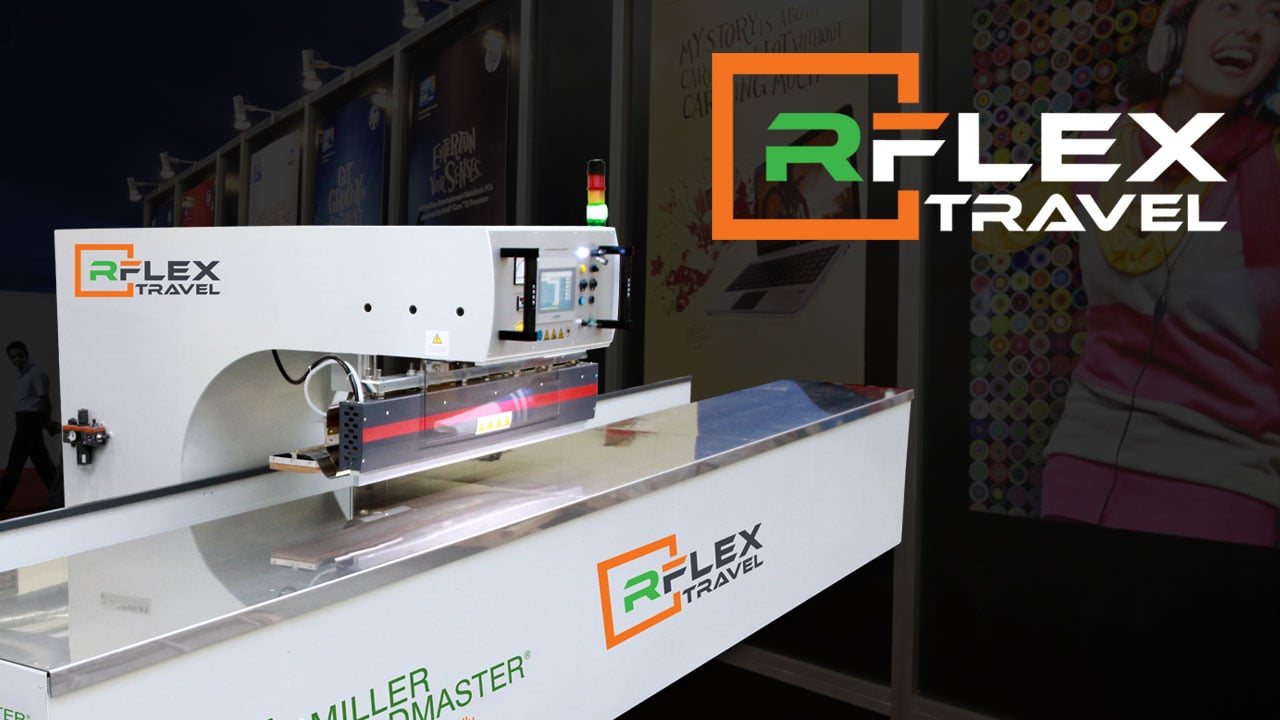
The RFlex Travel system is designed specifically for these large-format challenges. Instead of forcing material through a machine, it allows the welding head to travel along a precision track, which can reduce handling labor, improve production time, and increase speed on large jobs. It is a radio frequency (RF) welder, so the traveling head bonds PVC and PU seams with RF energy rather than hot air or a hot wedge.
Where It Delivers Value
- Billboard Production: Long seams can be completed in a single pass without repositioning, making the system suitable for larger sizes that would be difficult to handle on stationary equipment.
- Building Wraps: Large panels remain flat and stable, improving accuracy
- Oversized Event Graphics: Reduces handling time and improves production efficiency for trade show displays and other commercial presentation work such as large-format banners, posters, and billboard faces that require a professional finish.
This approach allows manufacturers to expand output while maintaining high-quality results without increasing labor demands.
What a Shop Needs Before Installing a Traveling System
Installing a traveling welder requires planning:
- Dedicated floor space for the track system
- Electrical and compressed air connections
- A permanent installation layout
Also plan a material staging area around the track. A Miller Weldmaster certified field service engineer installs the machine and trains your operators at your facility.
The RFlex Travel can also be fitted with the optional FREEWeld system, which removes the need for the grounding foot to sit perfectly flat on the table, so operators can make a wider range of products.
Compared to a compact machine like the T300 Extreme Edge or other sign finishing and banner welding machines, a traveling system represents a larger facility commitment—but delivers significant advantages for oversized work.
Materials the RFlex Travel Can Weld
The RFlex Travel is a radio frequency welding machine. Instead of heating the surface with hot air or a hot wedge, RF energy heats compatible materials from within, which gives airtight, waterproof seams with a clean look. It welds:
- Scrim-reinforced PVC vinyl and blockout PVC
- Polyurethane (PU) and TPU-coated fabrics
- Reinforced technical textiles and film
Non-polar plastics such as polyethylene and polypropylene, and fabrics such as nylon, don’t respond to RF energy, so they are welded with hot air or hot wedge machines instead. Always test your material before choosing RF welding for production.
Full specifications are on the RFlex Travel page.
Deciding Between a Traveling Welder and a Stationary Machine
Choosing the right system depends on the type of work your shop handles, your production volume, and your specific needs, including whether you rely on banner welders for custom signage projects.
| Factor | Stationary Machine | Traveling Welder |
|---|---|---|
| Typical Job Size | Standard banners | Oversized panels |
| Material Handling | Material moves through machine | Material stays stationary |
| Seam Length | Limited by machine size | Virtually unlimited |
| Facility Footprint | Compact | Large, fixed installation |
| Best Fit | Everyday production | Large-format projects |
Selecting the right equipment depends on job size, throughput, and workflow demands, all of which affect overall performance.
Most shops benefit from using both systems—stationary machines for standard work and traveling welders for oversized jobs, and evaluating the ROI of banner welding machines for sign shops can clarify how each system contributes to profitability.
For RF work, Miller Weldmaster offers both: the stationary RFlex suits medium-sized panels and standard runs, while the RFlex Travel fits when panels are very large and long seams are common. Both use the same RF technology and give the same weld quality; the difference is how the material moves.
Building a Traveling Welder Into an Existing Sign Shop Workflow
Integrating a traveling system requires thoughtful planning:
- Route oversized jobs to the traveling station early
- Stage materials around the fixed track system
- Batch large-format jobs to maximize efficiency and improve speed on oversized runs
- Maintain stationary machines for smaller work
- Train operators on alignment and setup procedures
Better workflow planning can enhance overall banner production efficiency for the business.
This approach ensures the traveling system enhances productivity without disrupting existing workflows.
On-Site and Large-Format Finishing Use Cases
It’s important to understand that a traveling welder does not travel to job sites. It is a fixed system designed for in-shop production.
For on-site finishing or repairs, portable vinyl and PVC welding equipment is still required as the right tool for the field allows repairs directly at the location of damaged structures and supports on-site customization for unique spaces.
Traveling welders are best suited for:
- Pre-production of large panels
- Controlled manufacturing environments
- High-volume oversized jobs
They complement—not replace—other finishing methods.
Related Guides
- Welding large-format signs and banners
- Double hem banner welding with the DH7600
- Keder edges for signs and structures
- When hot wedge beats hot air for signs
Frequently Asked Questions About Traveling Welders for Banners and Signs
What is a traveling welder for banners and signs?
A traveling welder is a system where the welding head moves across stationary material, allowing large panels to be welded without repositioning. In banner welding, it is an essential tool for handling oversized banner materials while the material stays stationary.
When do I need a traveling welder instead of a stationary machine?
A traveling welder is ideal when working with oversized banners, building wraps, or billboard panels that exceed the capacity of standard machines. Compared with traditional sewing methods, sewing is often less effective on these jobs because welded banner finishing techniques produce more durable bonds and seams on large banners.
Does the RFlex Travel replace stationary welding machines in a sign shop?
No. Most shops use traveling welders alongside stationary machines to handle different job sizes and production needs. Shops should also evaluate suppliers by comparing their range of welding machines, the expert advice they provide, and the key features that best fit banner and sign work, including guidance on what to consider when finishing signs or banners. When adding a second system to the shop, ongoing support, training, maintenance, and warranty coverage also matter.
What facility requirements does a traveling welder need?
Traveling welders require dedicated floor space, electrical connections, and a fixed installation layout to support the track system.
What materials can a traveling welder process?
Traveling welders can process flexible materials commonly used in signage, and banner welding machines that utilize hot wedge welding for banners and flexible materials handle various materials like vinyl and PVC used for vinyl banners and related displays. That material compatibility is key to producing high quality finished products.
How does a traveling welder create durable seams and improve seam quality on large panels?
By keeping the material stationary and moving the welding head, the system reduces handling errors and allows for longer, more consistent seams. That also creates cleaner edges that help carry the intended message in finished displays, supporting advertising use and helping attract customers with a better presentation.