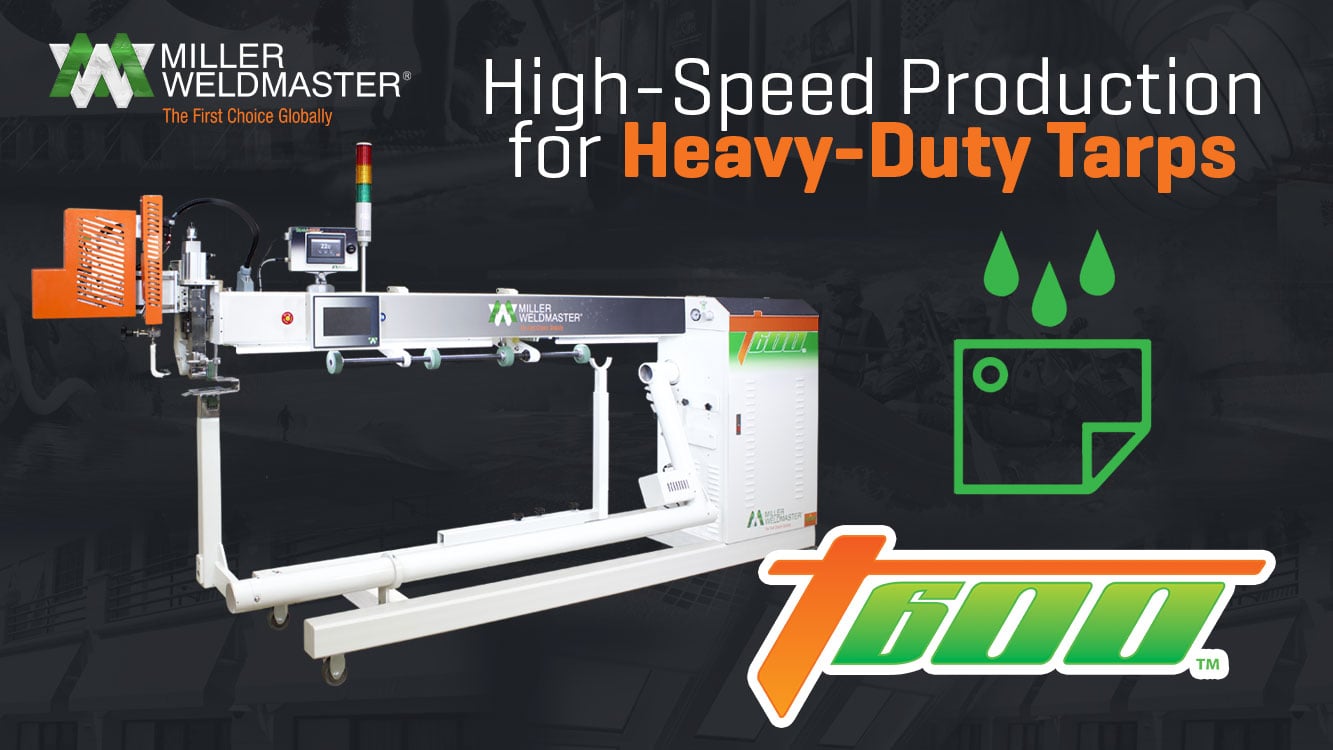
The T600 tarp welding machine is a heavy-duty hot air and hot wedge welder built for high-volume production of PVC, PE, PU, and specialty tarps, capable of welding large panels, storing up to 25 parameter recipes, and supporting continuous multi-shift manufacturing.
As tarp manufacturers grow, production challenges become more difficult to manage. Wider materials, thicker fabrics, increased seam counts, and operator consistency can all impact throughput and seam quality. Equipment that performed well for smaller runs may begin creating bottlenecks as demand increases.
For companies focused on tarpaulin and tarp production, selecting the right industrial fabric welding system becomes critical to maintaining efficiency, reducing waste, and delivering consistent products. The T600 was engineered specifically to address these production challenges while supporting high-volume manufacturing environments.
Key Takeaways: What High-Volume Tarp Manufacturers Need to Know About the T600
- The T600 utilizes both hot air and hot wedge welding technologies, allowing manufacturers to process PVC, PE, PU, and non-woven polyester fabrics on a single platform.
- An 81-inch throat width accommodates large tarp panels without folding, helping prevent panel distortion and seam alignment issues.
- Up to 25 stored welding recipes enable fast transitions between product types while maintaining process consistency.
- Dual-arm configurations support simultaneous dual seam sealing, reducing machine passes and labor requirements on long seam runs.
- Heavy-duty steel construction is designed for continuous multi-shift production and long-term operational reliability.
Why Standard Machines Struggle With Heavy-Duty Tarp Production
Heavy-duty tarp production places demands on equipment that many standard welding systems were never designed to handle.
As manufacturers increase output, several production variables begin working against smaller or lighter-duty equipment. Wider materials require greater panel support. Thicker fabrics require more precise temperature control. Higher production volumes expose inconsistencies that may not be noticeable during low-volume manufacturing.
When production requirements exceed machine capabilities, manufacturers often experience increased scrap, reduced throughput, operator frustration, and inconsistent seam quality.
The Variables That Break Lighter Welders on Heavy Tarp Runs
Manufacturers that understand common welding mistakes and how to avoid them are better equipped to keep seam quality high as production demands increase.
Common production stressors include:
- Large panel widths exceeding 60 inches
- Thick materials ranging from super heavy-duty tarps at 12 mil thickness with 7 oz. fabric weight per square yard to 15-40 oz PVC-coated fabrics
- High daily seam counts across multiple shifts
- Frequent material changeovers requiring parameter adjustments
- Reinforced hems and rope hems requiring additional welding consistency
| Production Constraint | What Happens on Under-Specified Equipment |
|---|---|
| Panel width over 60 inches | Material folds, causing seam misalignment |
| Material weight over 15 oz | Inconsistent heat penetration and seam quality |
| Multiple product runs per shift | Increased setup time and operator error |
| Long seam counts per day | Throughput limitations and production bottlenecks |
| Thick hem finishing | Difficulty maintaining seam consistency |
When Is It Time to Move to a Production-Grade Tarp Welder?
Manufacturers should evaluate upgrading when:
- Seam failure rates increase as production volume grows.
- Throughput targets are consistently missed.
- Operators spend excessive time adjusting welding settings.
- Wide panels must be folded to fit through equipment.
- Changeovers create significant scrap and downtime.
These signals often indicate that production constraints stem from equipment limitations rather than operator performance.
What the T600 Is Built to Do — Machine Overview for Tarp Manufacturers
The T600 is Miller Weldmaster's production-grade tarp welding machine engineered specifically for high-volume tarp and tarpaulin manufacturing.
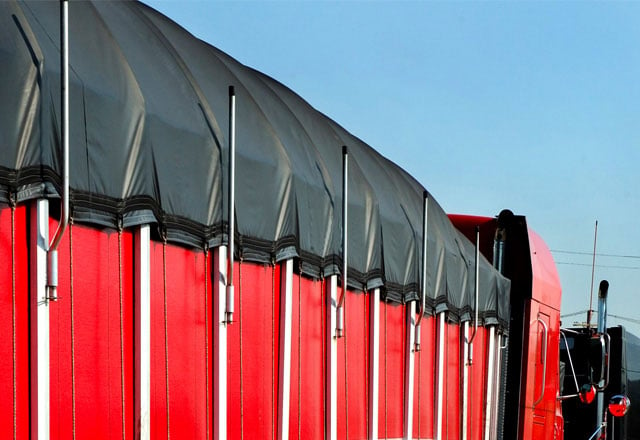
Designed for manufacturers producing truck tarps, agricultural covers, industrial covers, construction tarps, tents, and specialty fabric products, the T600 combines dual-heat welding technology, advanced controls, and heavy-duty material handling systems into a single platform.
The machine is available in several configurations, including the T600 Extreme Cover, allowing manufacturers to tailor automated tarpaulin welding solutions to their specific applications.
Dual-Heat System — Hot Air and Hot Wedge on One Machine
Hot air welding uses heated air to soften thermoplastic materials before pressure creates the weld, and understanding what hot air welding is helps manufacturers optimize settings for different fabrics. Hot wedge welding uses a heated metal wedge that transfers heat directly between material layers.
Having both hot wedge welding technologies available provides flexibility for manufacturers running multiple product types. PVC truck tarps, agricultural covers, and specialty materials may require different welding approaches. The ability to utilize either process on one machine eliminates the need for separate production equipment. Operators can switch between hot air and hot wedge welding based on the material and seam requirement.
81-Inch Throat Width — Why Panel Clearance Is a Production Variable, Not a Spec Number
The 81-inch throat width allows large tarp panels to move through the machine without folding or bunching. It can weld materials up to 78 inches wide, which helps when handling long or wide panels on larger projects.
When wide panels must be folded to fit through equipment, seam alignment becomes more difficult, increasing the risk of rework and scrap. Larger clearance helps maintain consistent material handling, particularly during long seam runs and longer panel length demands.
Temperature Control and Welding Parameters
The T600 regulates temperature up to 1350°F (730°C) through automated control systems.
Precise welding parameters are essential because different materials require different heat levels, speeds, and pressure settings. Accurate control helps prevent both under-welded seams and material burn-through, resulting in greater consistency across production runs.
T600 Key Specifications
| Specification | Value | Production Relevance |
|---|---|---|
| Throat Width | 81 inches | Accommodates large panels without folding |
| Max Material Width | 78 inches | Handles full-size tarp sections |
| Max Temperature | 1350°F / 730°C | Precise control across material types |
| Recipe Storage | 25 recipes | Faster changeovers |
| Power | Approx. 6kW | Continuous industrial operation |
| Seam Configurations | Multiple | Supports complete tarp finishing |
How the T600 Reduces Cycle Time on Heavy-Duty Tarp Production
Reducing cycle time is one of the most important goals for high-volume tarp manufacturers.
The T600 addresses production efficiency through multiple process improvements that impact throughput, labor utilization, and material waste, drawing on Miller Weldmaster's broader range of industrial hot air and wedge plastic welding machines.
Dual Seams in One Pass — Simultaneous Sealing Reduces Labor and Machine Time
The T600's dual arms support simultaneous dual seam sealing, allowing two seams to be completed during a single machine pass.
For manufacturers producing long truck tarp panels or industrial covers, this faster seam process supports quick production runs, reducing machine passes to lower labor requirements while increasing output while leveraging the advantages of hot wedge welding technology.
Recipe Storage and Repeatable Head Adjustments — Protecting Output at Shift Change
Recipe storage and repeatable head adjustments eliminate many of the challenges associated with product changeovers.
Consider a manufacturer switching from a 15 oz PVC truck tarp to a PE agricultural cover. Without stored recipes, operators must manually adjust temperature, speed, and pressure settings. This often results in test welds and scrap while settings are fine-tuned.
With 25 stored recipes, operators simply select the correct program and begin production with confidence. This minimizes waste while maintaining seam consistency across multiple shifts. Stored recipes and repeatable settings also help support optimal performance across shifts and operators.
Fabric Handling for Large, Heavy Panels
Heavy-duty materials can be difficult to manage during production.
The T600's material support systems improve easier fabric handling, helping operators maintain alignment and tension throughout long seam runs. Better fabric handling translates into fewer interruptions, fewer seam resets, and reduced material waste.
Materials the T600 Welds — What Heavy-Duty Tarp Manufacturers Actually Run
The T600 welds thermoplastic-coated fabrics commonly used throughout the tarp industry, similar to Miller Weldmaster's broader line of industrial tarpaulin welding machines.
Material selection impacts welding performance, seam strength, and parameter requirements. While the machine supports a wide range of fabrics, optimal results depend on selecting appropriate settings for each material.
| Fabric Type | Common Applications | Recommended Welding Method | Key Consideration |
|---|---|---|---|
| PVC-Coated Polyester | Truck tarps, industrial covers | Hot air or hot wedge | Strong seams and broad processing window |
| PE | Hay tarps, agricultural covers | Hot air | Narrow temperature window |
| PU-Coated Fabrics | Side curtains, specialty tarps | Hot air or hot wedge | Lower temperatures than PVC |
| Non-Woven Polyester | Agricultural and specialty covers | Hot air | Confirm weldability before production |
PVC — The Default Material for High-Demand Tarp Production
PVC remains the most widely used material for heavy-duty tarp manufacturing because PVC heavy-duty tarps are reliable and suited for demanding outdoor applications. Such products are often constructed as high quality tarps that feature 1200 denier material for tear resistance and heat-sealed seams to eliminate stitch holes. These details help protect against rain, wind, grease, mildew, and UV exposure; UV inhibitors slow material breakdown in harsh weather conditions while helping the tarp withstand wear and preserve structural integrity and material integrity.
The T600's dual-heat design is particularly effective for PVC applications because manufacturers can utilize either hot air or hot wedge welding depending on seam requirements and production preferences.
PE and Specialty Fabrics — Where Precise Parameter Control Pays Off
PE materials often require greater process precision than PVC.
Because polyethylene can have a narrower processing window and varying formulations, stored welding parameters become especially valuable. Once optimal settings are established, operators can save and recall recipes to ensure consistent performance across future production runs. Precise parameter control also supports specialty solutions, including inflatable products that require airtight seals.
Tarp Types the T600 Produces — Applications by Industry
The T600 supports a broad range of tarp manufacturing applications across multiple industries.
Whether producing transportation covers, agricultural protection systems, or industrial containment products, manufacturers benefit from the machine's versatility and production capacity, including the ability to produce heavy-duty tarps with finishing details such as rust-resistant grommets spaced every 18 inches when secure tie-downs are required.
| Tarp Type | Primary Material | Industries Served |
|---|---|---|
| Truck Tarps & Flatbed Covers | PVC, Vinyl | Transportation, Freight |
| Hay Tarps & Grain Covers | PE | Agriculture |
| Construction Tarps | PVC, Polyethylene | Construction |
| Industrial Covers | Heavy Vinyl, PU | Manufacturing |
| Tent & Shelter Panels | PVC | Events, Military, Emergency Response |
| Pool Covers | PVC, PE | Recreation |
Manufacturers interested in expanding their product portfolio may also explore additional and unexpected applications for heavy-duty tarps, potentially supported by custom converting welding equipment for specialized projects.
How to Weld Heavy-Duty Tarps on the T600 — Setup and Parameter Guidance
Successful tarp welding begins with proper machine setup and process control.
Follow these steps when establishing a new production run:
- Select the welding technology. Choose hot wedge for thick PVC and vinyl materials. Use hot air for PE and lighter coated fabrics.
- Set temperature and speed parameters. Begin with material supplier recommendations. Use test welds to fine-tune settings. The T600 provides temperature control up to 1350°F (730°C).
- Configure the seam type. Select overlap seams, hems, rope hems, or specialty seam configurations using appropriate guides.
- Store the recipe. Once optimal results are achieved, save the settings for future use. The machine stores up to 25 unique recipes.
- Feed and align the panel. Use machine support systems to maintain proper tension and alignment during welding.
- Run production and monitor seam quality. Verify that seams show proper material fusion rather than surface adhesion. Adjust speed before temperature whenever possible.
For additional guidance on materials and welding techniques, manufacturers should review a comprehensive tarpaulin welding machine guide, seam strength and welding basics, and advanced tarp heat sealing tips.
Ready to Scale Your Tarp Production? Talk to Miller Weldmaster
When production demands exceed the capabilities of existing equipment, manufacturers need a solution that improves throughput without sacrificing seam quality.
The T600 was engineered specifically for high-volume tarp production, combining dual-heat technology, large-panel handling, recipe storage, and production-focused controls into a single machine. Whether your operation manufactures truck tarps, agricultural covers, industrial covers, or specialty fabric products, the T600 provides the capacity and consistency required for long-term growth.
Miller Weldmaster also provides installation, operator training, and ongoing technical support to help manufacturers maximize performance from day one. The team also helps customers with training, shipping coordination, and tailored solutions for reliable startup and long-term performance. To learn more or discuss your application, contact Miller Weldmaster or use the company’s toll-free line to request assistance.
Frequently Asked Questions — T600 Tarp Welding Machine
What is the T600 tarp welding machine?
The T600 is Miller Weldmaster's heavy-duty hot air and hot wedge welding machine designed for high-volume production of tarps, covers, and tarpaulins. It welds thermoplastic-coated fabrics including PVC, PE, and PU, reflecting Miller Weldmaster's reputation as a trusted brand for heavy-duty tarp welding equipment, while providing large-panel handling capabilities. The machine supports up to 25 stored welding recipes and is designed for continuous industrial operation.
What is the difference between hot air and hot wedge welding for tarps?
Hot air welding uses heated air to soften material surfaces before pressure bonds them together. Hot wedge welding uses a heated metal wedge that directly transfers heat between fabric layers. Hot wedge is often preferred for thick PVC materials, while hot air offers greater flexibility for PE and lighter coated fabrics.
What tarp materials can the T600 weld?
The T600 welds PVC-coated polyester, polyethylene (PE), polyurethane (PU), and non-woven polyester materials. It can also process other compatible thermoplastic-coated fabrics used throughout tarp manufacturing. Materials that cannot be heat welded generally require alternative joining methods.
How does recipe storage improve tarp production efficiency?
Recipe storage allows operators to save complete welding parameter sets and recall them instantly. This eliminates manual parameter entry, reduces setup time, minimizes scrap during changeovers, and improves consistency across multiple shifts and operators.
What seam configurations does the T600 support for tarp production?
The T600 supports flat overlap seams, hems, hem-with-rope seams, pockets, and additional configurations through interchangeable guides and accessories. These seam options allow manufacturers to produce reinforced edges and specialized tarp constructions required across different industries.
When should a tarp manufacturer upgrade to a machine like the T600?
Manufacturers should consider upgrading when seam quality issues increase, production targets are not being met, changeovers consume excessive time, or wide panels create handling problems. These indicators often suggest that production limitations stem from equipment capability rather than workforce performance. Upgrading can improve reliable output and better support customers as order volume grows.