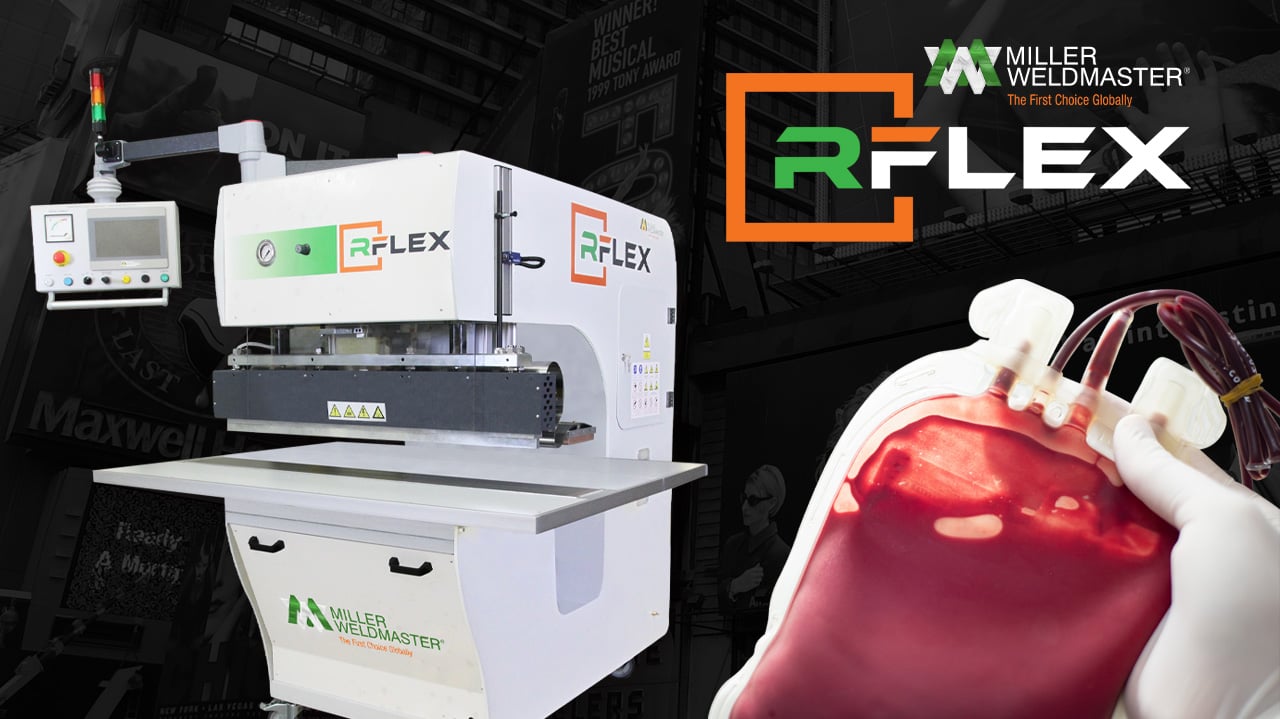
Radio frequency (RF) welding is the technology behind hermetic seals in some of the most critical healthcare products used every day—blood bags, IV fluid pouches, pressure cuffs, and surgical drapes. Unlike surface-based sealing methods, RF welding generates heat from within the material itself, creating molecular-level bonds that withstand fluid pressure, repeated inflation cycles, and sterilization processes.
For manufacturers in the medical and healthcare space, the difference between a reliable product and a failed one often comes down to the seam. RF welding has become the standard because it produces consistent, airtight, and biocompatible seals without the need for adhesives, thread, or solvents.
This article explores how RF welding works, which materials are compatible, the healthcare applications that depend on it, and what to look for when evaluating RF welding equipment for production.
Key Takeaways
- RF welding creates hermetic seals by heating thermoplastic materials internally using electromagnetic energy at 27.12 MHz.
- PVC and polyurethane (PU/TPU) are the primary materials used in healthcare RF welding applications.
- Common applications include blood bags, IV pouches, pressure cuffs, surgical drapes, and ostomy products.
- No adhesives or solvents are required, eliminating contamination risks.
- Consistent weld parameters—power, time, and cooling—are essential for reliable production.
In this article:
- What is RF welding and why it matters for healthcare products
- RF welding vs. other healthcare sealing methods
- Which healthcare products use RF welding
- Material compatibility
- How RF welding creates a hermetic seal
- What to look for in RF welding equipment
- Choosing an RF welder: RFlex vs. RFlex Press
- How Miller Weldmaster supports healthcare manufacturers
- Frequently asked questions
What Is RF Welding and Why Does It Matter for Healthcare Products?
RF welding, also known as dielectric or high-frequency welding, is a thermoplastic joining process that uses electromagnetic energy to generate heat inside compatible materials. Two electrodes apply pressure while the RF field causes polar molecules to oscillate, creating friction and heat. The material softens and fuses, forming a bond that is often as strong as the base material itself. RF welding emerged in the 1940s for military applications before expanding into medical manufacturing.
This internal heating mechanism is what sets RF welding apart. Traditional methods like hot air welding apply heat externally, which can result in uneven bonding—especially in multi-layer materials. Adhesives introduce chemical risks, and sewing creates needle holes that compromise seal integrity.
RF welding eliminates these issues entirely, making it the preferred method for fluid-contact healthcare products.
Why the Seam Is the Failure Point
In medical device manufacturing, the material rarely fails first—the seam does, and seam quality can directly affect patient care. Products such as blood bags and IV pouches are subjected to pressure, handling, and temperature changes. Any weakness in the seam can lead to leaks, contamination, or complete failure.
Because of this, the joining process is treated as a critical quality variable. RF welding provides the consistency and reliability required where failure is not an option.
RF Welding vs. Other Healthcare Sealing Methods
| Method | Heat Source | Hermetic Seal | Adhesives Required | Typical Use |
|---|---|---|---|---|
| RF Welding | Internal (electromagnetic) | Yes | No | Fluid bags, pressure devices |
| Hot Air Welding | External | Partial | No | Single-layer films |
| Ultrasonic Welding | Internal (vibration) | Yes | No | Non-woven disposables |
| Adhesive Bonding | Chemical | Variable | Yes | Non-fluid applications |
| Sewing | Mechanical | No | Yes | Structural textiles |
Which Healthcare Products Use RF Welding?
RF welding is widely used in the healthcare industry and medical industry for typical applications that require an airtight seal in medical products made from thermoplastic materials, especially where hermetic, biocompatible seals are essential.
Fluid Delivery and Collection Devices
Products like IV bags, blood collection bags, chemotherapy pouches, and drainage bags rely on RF welding to maintain sterility and prevent leaks. These rf welded products often also need ports or other integrated components, and RF welding supports that integration during device manufacturing while maintaining sterile, leak-resistant seams. These applications require not only strength but complete hermetic sealing—preventing both liquid and vapor transmission.
Inflatable and Pressure-Based Devices
Blood pressure cuffs, tourniquets, and compression garments must withstand repeated inflation cycles. RF welded seams distribute stress evenly across the bond, preventing failure over time.
Surgical and Sterile Field Products
Surgical drapes and sterile packaging require clean, particle-free seams. RF welding produces smooth, fused surfaces without introducing fibers or residue, and thermoplastic polyurethane is a common choice for sterile packaging and barrier applications because of its durability and biocompatibility.
Ostomy and Wound Care Products
Ostomy bags and wound drainage pouches must combine leak-proof performance with patient comfort. RF welding ensures both durability and a smooth contact surface.
Material Compatibility: What Can and Cannot Be RF Welded
Radio frequency welding, also called dielectric welding or RF sealing, is a material-dependent process that works with polar thermoplastics—materials that respond to electromagnetic fields.
Compatible Materials
- PVC (Polyvinyl Chloride): Most common in blood bags and IV pouches
- Polyurethane (PU/TPU): Used for pressure and skin-contact applications
- EVA (Ethylene-Vinyl Acetate): Alternative to PVC in some applications
- TPU-Coated Fabrics: Used in inflatable and orthopedic devices
Non-Compatible Materials
- Polypropylene (PP)
- Polyethylene (PE)
- Polystyrene (PS)
These plastics are non-polar, so they need a different joining method, such as impulse welding for healthcare packaging or ultrasonic welding.
How RF Welding Creates a Hermetic Seal
The RF welding process consists of four critical phases, reflecting RF welding techniques used in RF welding technology to form hermetic seals:
1. Material Positioning
Materials are placed between electrodes, and die design determines the weld shape and structure, while the welding tool sets the final seam geometry and can produce unique shapes.
2. RF Energy Application
A specialized welding machine applies radio frequency energy through high frequency waves, creating an electromagnetic field of high frequency electromagnetic energy that heats the plastic surfaces internally rather than through external heat, and it must generate enough heat for proper fusion.
3. Pressure and Bond Formation
Controlled pressure ensures proper molecular fusion; after heating, applying pressure helps produce a good weld with leak proof seams. Too much or too little pressure affects seal quality.
4. Cooling and Solidification
Pressure is maintained during cooling to lock in the bond and ensure strength, helping preserve a seam that can be stronger than the original material.
What “Hermetic” Really Means
A hermetic seal prevents any gas or liquid from passing through the seam under real-world conditions. This includes storage, transport, and repeated use. RF welding achieves this by bonding the entire seam cross-section—not just the surface.
What to Look for in RF Welding Equipment for Healthcare Applications
For a broader checklist, see our guide to evaluating medical fabric welding equipment.
Parameter Control and Repeatability
Consistent weld quality depends on precise control of power, time, and cooling. Machines with autotuning capabilities ensure repeatability across production runs.
Arc and Overload Protection
Advanced systems detect and prevent arcing, protecting both the material and tooling from damage.
Tooling Flexibility
Quick die change systems allow manufacturers to switch between products efficiently, supporting multiple SKUs.
Capability for Complex Geometries
Options like FREEWeld enable this welding technology to handle irregular shapes, complex geometries, and other unique forms without requiring flat grounding surfaces, even in high-volume production.
Custom System Integration
For specialized applications, custom RF systems can be engineered to match material requirements, production volumes, and product designs.
Choosing an RF Welder for Medical Production: RFlex vs. RFlex Press
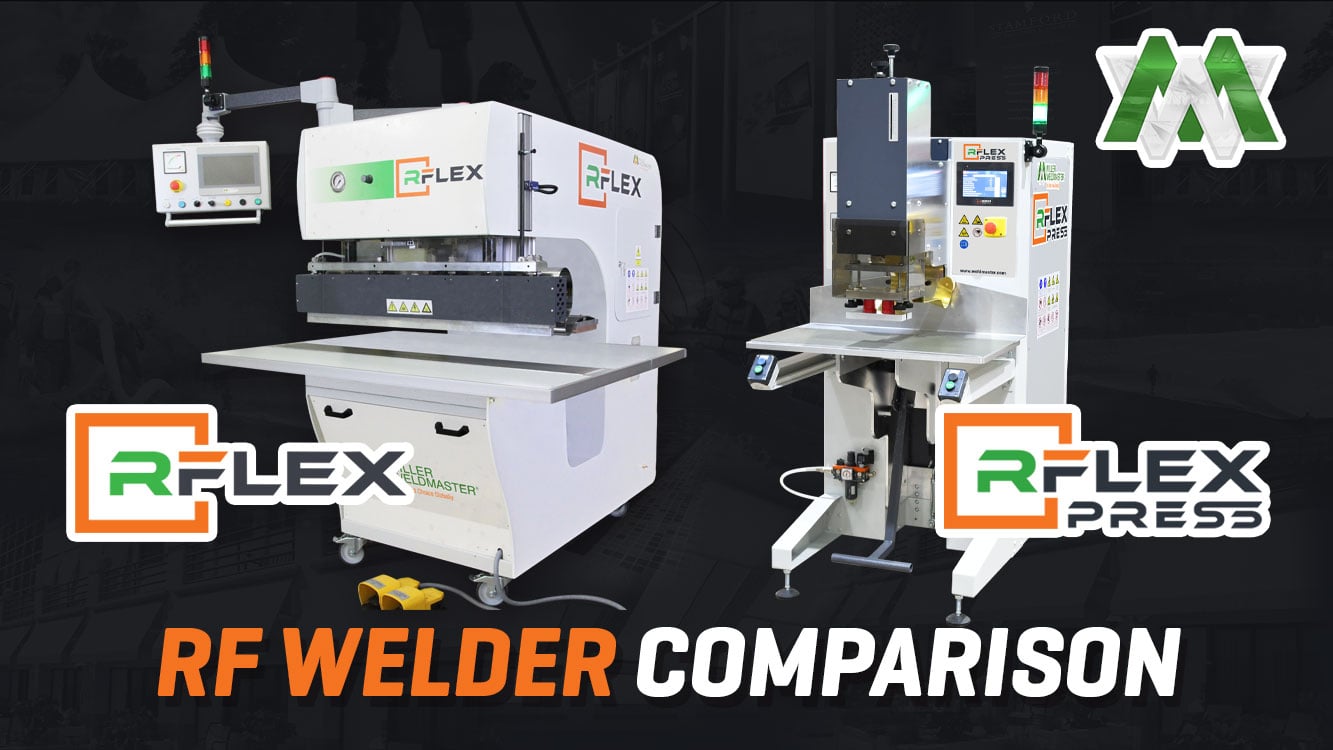
Both Miller Weldmaster RF welders use the same 27.12 MHz technology and produce the same seal quality, so the choice comes down to production role. Using the wrong machine creates bottlenecks: a press used for primary production slows the line, while an RFlex used for small components sits underused.
| Criterion | RFlex | RFlex Press |
| Primary role | High-volume primary production | Auxiliary component welding |
| HF power output | Higher range | 0.5–4 kW |
| Working area | Large | Compact |
| Material range | PVC, PU, TPU, reinforced technical textiles | Primarily PVC |
| Best-fit products | Bags, pouches, inflatables | Valves, tubing, grommets, small parts |
| Throughput | High | Moderate |
| Footprint | Dedicated installation | Compact; suits cleanrooms and tight spaces |
| Operation | Larger-scale automated production | Hands-on, manual operation |
| Weld recipes | Advanced | Programmable |
| Ideal context | Full production lines | Supporting operations |
The RFlex: Stationary, High-Throughput RF Welder
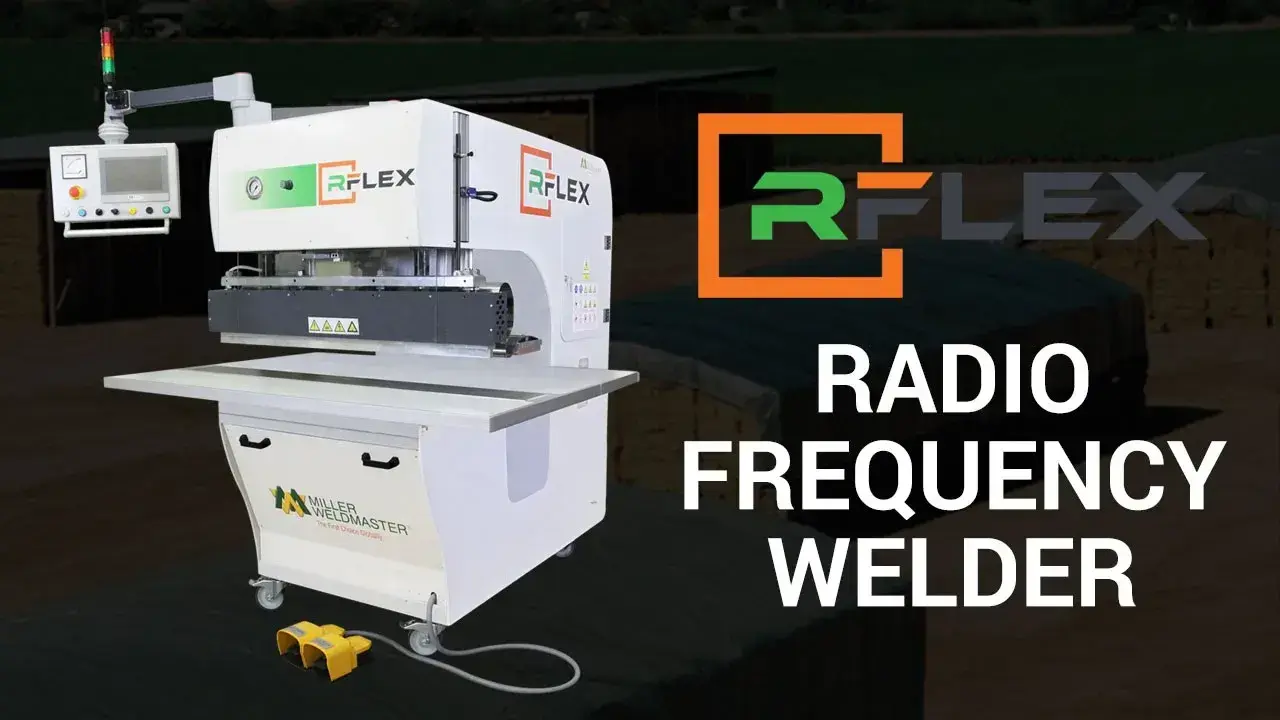
The RFlex RF welder is a stationary system for high-volume production and fits automated lines. Its larger working area, higher power range, and longer electrode capacity make it ideal for full-seam RF heat sealing of IV bags, blood bags, fluid pouches, and inflatable medical products.
The RFlex Press: Compact Precision Welder
The RFlex Press compact RF welder is the smallest machine in the line, with HF power output between 0.5 and 4 kW. It is built for auxiliary tasks such as attaching valves, tubing, grommets, and plates, and its compact footprint suits cleanrooms and constrained spaces. In medical manufacturing it typically works alongside a larger RFlex to complete the production workflow.
Bar, Rotary, and Shuttle RF Welders
Bar RF welders make straight-line welds on large products. Rotary RF welders use circular tables for continuous production and can handle multiple layers. Shuttle RF welders use sliding tables and suit medium-volume production.
Questions to Ask Before You Choose
- What is the primary production role?
- What production volume do you need?
- What space and infrastructure are available?
- Which materials will you weld?
- How will operators interact with the machine?
The right choice matches the machine to the workflow instead of forcing one machine to handle every role.
RF Welding vs. Other Joining Methods: Choosing the Right Approach
RF welding stands out for applications requiring hermetic seals and high reliability, and radio frequency welding technology is especially effective for mass production of healthcare products that require reliable seals. While other methods have their place, none match RF welding for fluid-contact healthcare products.
How Miller Weldmaster Supports Healthcare Manufacturers
Miller Weldmaster has decades of experience designing RF welding systems for industries where seal integrity is critical. Their cutting edge RF welding equipment for healthcare applications is built for precision, repeatability, and scalability.
The RFlex system, for example, delivers:
- Consistent power output with autotuning
- Advanced arc protection for product integrity
- Programmable weld recipes for multiple applications
- Quick die change systems for efficient production
- Flexibility for complex product geometries
These capabilities make it a reliable solution for manufacturers producing healthcare products that demand airtight, durable seals.
Frequently Asked Questions
What is RF welding used for in healthcare?
RF welding is used to create hermetic seals in products like blood bags, IV pouches, pressure cuffs, and surgical drapes.
Which materials can be RF welded?
PVC, PU/TPU, EVA, and TPU-coated fabrics are commonly used. Non-polar materials like PE and PP are not compatible.
Why is hermetic sealing important?
Hermetic seals prevent fluid leaks, air loss, and contamination—critical for patient safety and product performance.
Does RF welding require adhesives?
No. RF welding bonds materials without adhesives, solvents, or thread.
How fast is the RF welding process?
Typical weld cycles range from 4–12 seconds, plus cooling time, making RF welding efficient for high-volume production.
What is the difference between the RFlex and the RFlex Press?
The RFlex is a high-throughput stationary welder for large medical products, while the RFlex Press is a compact machine for precision welding of small components. Both use the same RF technology but serve different production roles.
Does the RFlex Press work for small medical component welding?
Yes. It is specifically designed for welding components such as valves, tubing, and grommets with high precision.
Conclusion
RF welding plays a critical role in modern healthcare manufacturing by enabling the production of reliable, hermetically sealed products. Its ability to create strong, contamination-free bonds makes it the preferred choice for fluid-contact and pressure-based medical applications.
For manufacturers looking to improve product quality, reduce failure risk, and streamline production, RF welding offers a proven and scalable solution.
Want to know how your material will seal? Send us a sample and we'll test it on our machines.