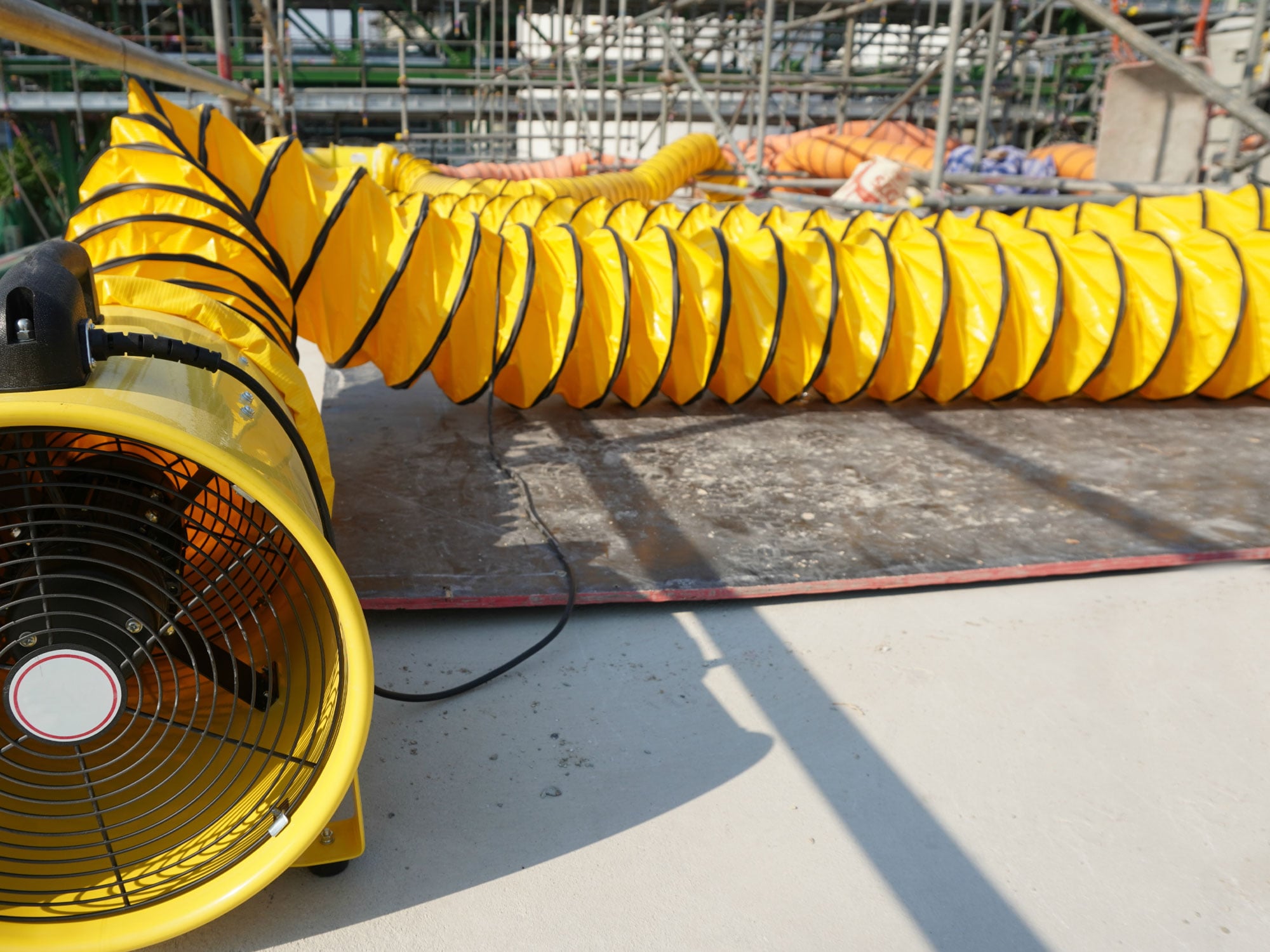
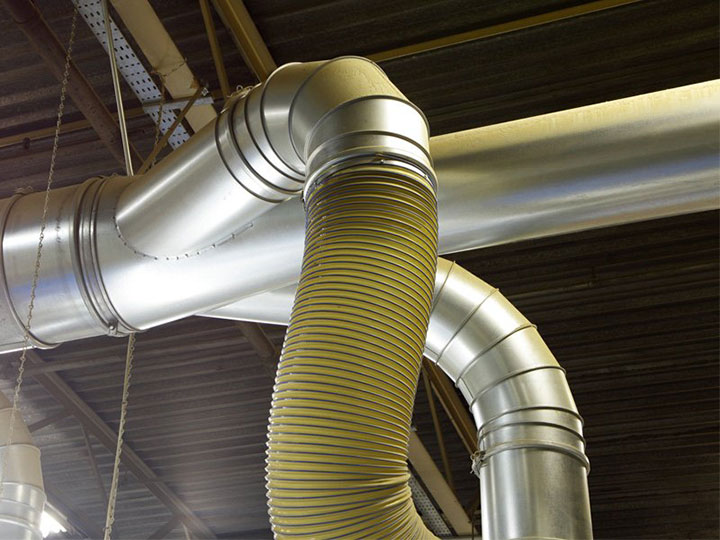
The T300 hot air welder produces strong, consistent seams on coated and laminated duct fabrics by applying controlled heat, pressure, and speed, eliminating the need for adhesives or stitching.
In ducting production, seam failure is not a small issue. It leads to rework, wasted material, downtime, and in some cases, failure in the field. When ducts cannot hold pressure or maintain integrity under temperature variation, the cost compounds quickly.
Manufacturers are under pressure to produce more while maintaining consistent quality. That means reducing operator variability and eliminating weak points in the process. Seams are often the weakest link.
This is where the Miller Weldmaster T300 hot air welder fits. It is built specifically for production environments that require repeatable, high-strength seams in thermoplastic materials used in fabric ducting production. The T300 is known for its versatility, being used across industries such as signage, tents and structures, inflatables, industrial fabrics, and specialty products. Common products manufactured with the T300 Flex include tents, banners, inflatables, awnings, and ducting, demonstrating its adaptability to diverse materials. Learn more about the industry here:
https://www.weldmaster.com/industries/ducting
This article breaks down how the T300 works, why seams fail, and how manufacturers use it to produce durable HVAC duct fabric at scale. The value and efficiency of the T300 Flex can lead to a rapid return on investment through direct savings in materials and labor, making it a cost-effective solution for manufacturers.
Duct Seams That Hold: What the T300 Gets Right
- The T300 is a hot air welder designed for high-volume production of coated and laminated thermoplastic fabrics used in HVAC ducting
- It fuses materials using controlled heat, speed, and pressure, eliminating thread and adhesives
- The machine supports both hot air welding and hot wedge welding for different material types
- Operators can store weld recipes, allowing repeatable seam quality across shifts
- Welded seams can match or exceed the strength of the base fabric
- The T300 Flex features a precision welding head and adjustable heating head, enabling enhanced accuracy and efficiency in the welding process
- The T300 reduces operator variability and improves consistency in production environments by enabling precision welding and precision adjustments. Repeatable head adjustments and head adjustments ensure consistent seam quality, high efficiency, and reduced labor costs.
Why Fabric Duct Seams Fail — and What That Costs Manufacturers
Seam failure typically shows up in two ways. First is lack of bond strength, where seams peel or separate under pressure. Second is inconsistency, where seams vary across a production run.
Both lead to real costs.
| Failure Mode | Production Impact |
|---|---|
| Seam separation under pressure | Product failure and returns |
| Adhesive delamination | Rework and scrap |
| Stitched seam air leakage | Reduced system efficiency |
| Inconsistent seam width | Quality control issues |
| Operator variability | Production slowdowns |
Every failure creates waste. Material is lost. Labor is spent fixing defects. Production lines stop. In HVAC systems, poor seams also reduce airflow performance.
The root issue is lack of control. Consistent seams require consistent parameters. That is what the T300 is built to deliver.
How the T300 Hot Air Welder Works
The T300 uses a controlled heating and pressure system to bond thermoplastic materials into a single, continuous seam. It is equipped with an intuitive touch screen interface that enables easy operation, allowing users to quickly adjust welding parameters for different tasks.
When describing variable controls, the T300's touch screen provides an intuitive control system, making it simple for operators to adjust settings as needed. This reduces training time and enhances production efficiency. The touchscreen interface also features recipe storage for up to 25 different material settings, streamlining setup and ensuring consistent results.
The Hot Air Welding Process in Plain Terms
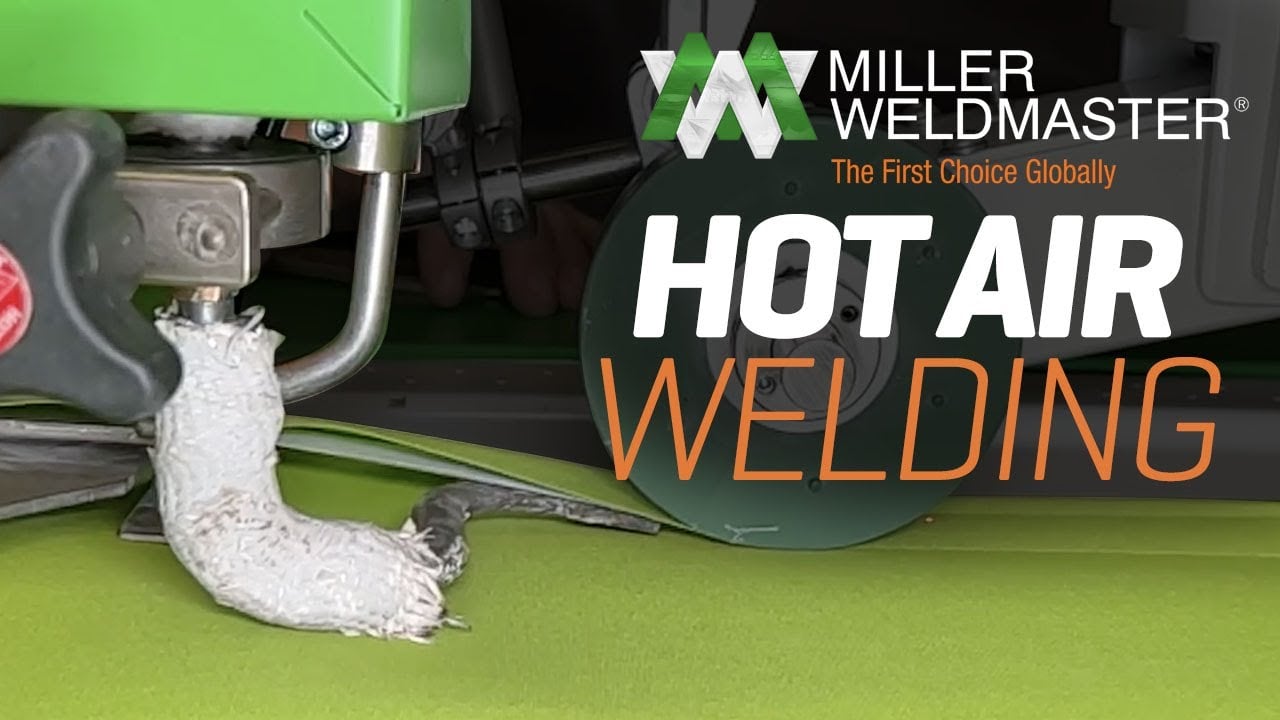
Hot air welding heats thermoplastic surfaces to a fusion point and applies pressure to bond them together.
The T300 controls three critical variables:
| Variable | What It Controls | Effect If Out of Range |
|---|---|---|
| Temperature | Heat applied to material | Too low = weak bond, too high = material burn |
| Speed | Material feed rate | Too fast = incomplete weld, too slow = overheating |
| Pressure | Roller force | Too low = poor adhesion, too high = deformation |
These variables work together. If one drifts, seam quality drops.
The T300 stores these settings as weld recipes, allowing operators to repeat the same results across runs.
Hot Air vs. Hot Wedge — When to Use Each Mode
The T300 supports both hot air welding and hot wedge welding, utilizing advanced air and hot wedge technologies to create strong, precise seams in industrial fabric applications.
| Feature | Hot Air | Hot Wedge |
|---|---|---|
| Heat Delivery | Heated air stream | Heated metal wedge |
| Best For | Thinner coated fabrics | Thicker or laminated materials |
| Seam Appearance | Clean exterior finish | Strong internal bond |
| Speed | Moderate | Higher efficiency on thick materials |
| Application | Interior seams, visible surfaces | Structural seams, heavy-duty ducting |
For HVAC duct production, the choice depends on material thickness and coating type. Thicker materials benefit from hot wedge. Thinner materials often perform better with hot air.
Hot air and hot wedge welding with the T300 Flex allows for faster production speeds than traditional welding methods, enhancing overall efficiency in manufacturing processes.
What Duct Fabrics Can the T300 Weld?
The T300 is designed for thermoplastic materials used in HVAC ducting.
| Material Type | Compatible | Welding Mode | Notes |
|---|---|---|---|
| PVC-coated fabric | Yes | Hot air or wedge | Most common duct material |
| PU-coated fabric | Yes | Hot air | Requires precise temp control |
| PE laminate | Yes | Hot wedge | Often used in lightweight ducts |
| Polyester reinforced | Yes | Both | Adds structural strength |
| Vinyl-coated fabric | Yes | Both | Durable and flexible |
| PTFE/glass fiber | No | N/A | Not thermoplastic |
Material type and thickness determine the correct recipe settings. Thicker coatings require more heat and slower speeds.
T300 Production Capabilities for HVAC Duct Fabricators
The T300 is a welding machine designed for high-volume production, specifically for banner and media finishing as well as ducting applications. Its advanced hot air and hot wedge welding technologies allow for precise, efficient seams, making it ideal for demanding industrial environments. The T300 requires minimal maintenance, which enhances its reliability and keeps operational costs low. Additionally, using the T300 Flex reduces material waste compared to traditional welding methods, resulting in significant cost savings during production.
Weld Speed and Throughput
The T300 can reach speeds up to 30 meters per minute (100 feet per minute).
In production terms, that means:
- High linear seam output per shift
- Faster turnaround on large duct runs
- Reduced bottlenecks compared to sewing
Actual speed depends on material thickness and seam type. Stored recipes allow operators to run at optimal speed without trial and error.
Seam Types Supported
The T300 supports several seam types used in duct construction:
- Overlap seams: primary structural seams for duct runs, with an overlap guide component to ensure precise seam alignment
- Hem seams: finished edges for durability and appearance, providing a clean edge for both strength and visual appeal
- Pocket seams: used for reinforcement or mounting
- Reinforcement seams: added strength in high-stress areas
Each seam type serves a purpose depending on the duct design.
Operator Controls and Recipe Management
The T300 includes a digital HMI touchscreen.
It stores up to 25 weld recipes.
Each recipe includes temperature, speed, and pressure settings for a specific material and seam type, with precision adjustments available for seam width, temperature, and other parameters to ensure high-quality, accurate welds.
The T300's modular assembly allows for easy customization and maintenance, letting operators quickly swap or upgrade components as needed.
This provides:
- Faster setup between jobs
- Reduced operator training time
- Consistent output across shifts
Instead of relying on operator skill, the process becomes system-driven.
Welding vs. Stitching — Why Ducting Manufacturers Are Switching
Stitching has been used for years. But it has limitations.
| Feature | Welded Seam | Stitched Seam |
|---|---|---|
| Bond Type | Fused material | Thread-based |
| Air Seal | Airtight | Perforated |
| Pressure Performance | High | Limited |
| Water Resistance | Strong | Weak |
| Consistency | High | Operator dependent |
| Material Requirement | Thermoplastic only | Any fabric |
Welded seams create a continuous bond. No holes. No thread.
Stitched seams introduce perforations that allow air leakage. Over time, they can weaken under pressure.
For thermoplastic duct fabrics, welding is the stronger and more consistent option.
Work With Miller Weldmaster on Your Ducting Production
Miller Weldmaster works directly with manufacturers to improve production processes.
That starts with application testing. Materials are evaluated, and weld parameters are developed. The goal is to ensure the machine fits the process before purchase. It is strongly recommended that the t300 hot air welder be inspected in person to verify its condition before purchase. The machine is sold as-is from the facility, with no return privilege. Typical lead time for delivery is usually within 12 weeks from order receipt. Comprehensive maintenance services, including operator training and the availability of genuine spare parts, are essential to ensure optimal performance of the T300 Flex over time.
If you are evaluating equipment, you can learn more about the T300 here:
https://www.weldmaster.com/t300-extreme-flex
You can also speak with the team directly:
Sales: https://www.weldmaster.com/contact-sales
Service: https://www.weldmaster.com/contact-service
Frequently Asked Questions About the T300 Hot Air Welder
What is the T300 hot air welder used for in HVAC duct manufacturing?
The T300 is used to weld seams in coated and laminated thermoplastic duct fabrics used in HVAC systems. It applies controlled heat, speed, and pressure to create strong, airtight seams. This replaces stitching, which can allow air leakage and reduce performance in pressure-based applications.
How does the T300 hot air welder work?
The T300 directs heated air onto thermoplastic material, softening it at the bond point. Roller pressure then fuses the layers into a single seam. Operators control temperature, speed, and pressure through a touchscreen interface, and these settings are stored as recipes for repeatable production.
What types of duct fabric can the T300 weld?
The T300 welds PVC-coated, PU-coated, PE-laminated, and polyester-reinforced thermoplastic fabrics. These are common in HVAC ducting. It does not work with non-thermoplastic materials like PTFE or glass fiber composites.
What is the difference between hot air welding and hot wedge welding for duct fabric?
Hot air welding uses heated air to soften the material without contact. It works well for thinner fabrics and clean seams. Hot wedge welding uses a heated metal blade between layers, providing more efficient heat transfer for thicker materials. The T300 supports both methods.
How fast does the T300 weld duct fabric seams?
The T300 can reach speeds up to 30 meters per minute, depending on material and seam type. Thicker materials require slower speeds. In production, stored recipes allow consistent operation without recalibration.
Can the T300 store different weld settings for different duct materials?
Yes. The T300 stores up to 25 weld recipes. Each recipe includes temperature, speed, and pressure settings. Operators can switch between materials quickly without manually adjusting parameters.
Is a welded duct seam stronger than a stitched one?
For thermoplastic materials, welded seams can match or exceed the strength of the base fabric. Stitched seams introduce holes that allow air leakage and can weaken under pressure. Welding creates a continuous bond with no perforations.
What should I do if T300 welds are inconsistent across a production run?
Check the weld recipe first. Ensure the correct settings are being used for the material. Inspect the rollers and heating system for wear or buildup. Parameter drift is the most common cause. If needed, contact service here: https://www.weldmaster.com/contact-service