What Every CIPP Liner Manufacturer Needs to Know
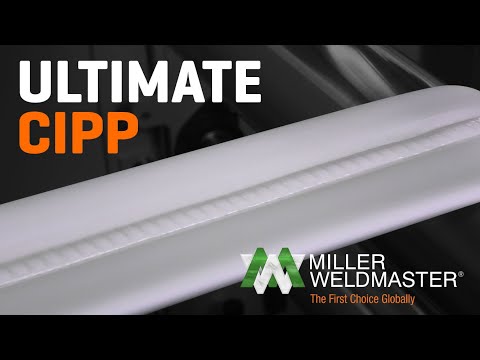
Cured in place pipeline (CIPP) welding machines are automated systems that weld and sew rolls of non-woven felt and coated fabric into the continuous liner tubes used for trenchless pipe rehabilitation. Miller Weldmaster's CIPP lines have produced millions of linear feet of liner worldwide.
Key Takeaways
- CIPP liner production requires fully automated welding or sewing systems — manual equipment cannot maintain the seam consistency or continuous run length commercial-scale liner demands.
- Producing liner in-house with a dedicated CIPP welding machine is typically more cost-effective than purchasing pre-manufactured liner, giving producers greater margin control and delivery flexibility.
- Machine configuration must match your liner construction: single-layer or double-layer, felt or coated fabric, overlap or butt seam — the wrong setup produces scrap, not product.
- Miller Weldmaster’s CIPP automation systems have produced millions of linear feet of liner worldwide and are configurable for both rehabilitation tubes and calibration tubes.
- After-sale support — operator training, spare parts availability, and process troubleshooting — is as important as machine specs when evaluating a CIPP equipment supplier.
Understanding CIPP Liner Manufacturing
What Is Cured In Place Pipeline Welding Equipment?
Cured-in-place pipeline (CIPP) welding equipment refers to fully automated industrial machinery used to manufacture CIPP liner from rolls of raw fabric. It is not field installation equipment. Miller Weldmaster designs and builds the machinery responsible for producing the liner long before it reaches the job site.
CIPP liner is a flexible fabric tube saturated with thermosetting resin and inserted into a damaged host pipe, where it cures in place to create a new pipe within the existing one. This process, known as cured-in-place pipe (CIPP), is a trenchless rehabilitation method used to repair damaged pipelines without excavation. The liner itself is the structural component — and the welding equipment is what produces it.
Before evaluating equipment, it’s important to understand the manufacturing process. The sections below explain how liner is produced, the types of machines involved, and the key factors to consider when specifying a system.
How CIPP Liner Is Manufactured?
CIPP liner manufacturing equipment produces continuous-length fabric tubes by automatically feeding, tensioning, and welding or sewing various materials, including non-woven felt and coated fabrics, into a sealed liner material ready for resin impregnation and installation. The process runs inline, so the system can weld or sew two layers of fabric simultaneously, and produces either one layer or two layers at scale. Equipment is available in various sizes to accommodate different project needs.
The production sequence follows these stages:
Unwind — rolls of non-woven felt and/or coated fabric are mounted on heavy-duty unwind stands. Roll weight and diameter are significant — the unwind system must maintain constant tension as the roll changes diameter.
Tension and feed — material feeds through a tensioning system that controls the feed rate into the bonding zone. Consistent tension is critical for seam quality throughout the run.
Bonding — the material enters the bonding zone where it is welded (hot air or hot wedge), sewn, or both, depending on the liner construction. For double-layer liners, this happens in a single inline pass, ensuring the liner material is evenly distributed inside the tube for proper coverage and structural integrity.
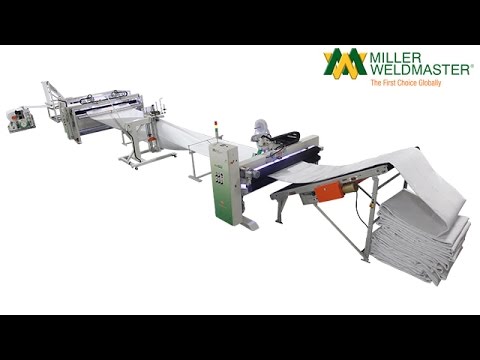
Outfeed and collection — outboard pullers flatten the finished liner and an incline conveyor fan-folds it, ready to ship. Production runs can be long — hundreds of linear feet without stopping.
No manual labor handles the material during production. Automation controls speed, temperature, tension, and seam consistency.
How CIPP Liner Manufacturing Differs from General Welding?
Buyers sometimes begin their search using general industrial welding terms. CIPP liner production is a distinct application. The materials involved — non-woven polyester felt, PVC-coated fabric, polyurethane-coated fabric — are not metal. The seams are long and continuous, not short-run spot welds. And the machine must handle large, heavy rolls with consistent tension control over the full run length. Standard industrial welding equipment is not engineered for this. Uncoated felt layers can't be heat-welded, so most liner production also needs industrial sewing. Miller Weldmaster’s CIPP systems are purpose-built for the material weights, run lengths, and seam tolerances that liner production demands.
CIPP Liner Manufacturing Applications and Configurations
CIPP liner is manufactured for several distinct markets, each with its own buyer segment and liner specification requirements based on the application. Miller Weldmaster’s machines are configured to align with the liner construction requirements of each market and can also be customized further to support specific project needs within those markets.
Sanitary and Storm Sewer Rehabilitation
Sanitary and storm sewer rehabilitation liner is usually double-layer: a non-woven felt inner layer that carries the resin and a coated felt outer layer (PVC, polyurethane, polyethylene or polypropylene). Miller Weldmaster's CIPP single or double layer machine sews or welds both layers inline in one pass, tack welds them together and applies tape with hot air over the sewn seam to make it waterproof.
Industrial Pipeline Restoration
Process piping, chemical drainage, and industrial infrastructure present different liner specifications. Wall thickness requirements are higher, coating chemistry may differ, and the operational consequence of a liner failure is greater than in municipal applications.
Liner for industrial restoration often incorporates heavier felt weights and more robust outer coatings. Miller Weldmaster’s configurable system architecture is compatible with high quality materials, ensuring durability and performance in industrial applications, and accommodates these higher-spec material combinations without requiring a separate machine.
Calibration Tube Production
Cal-Tubes are inflation bladders — not structural liners — inserted inside the liner during CIPP installation to press it against the host pipe wall as the resin cures; without a properly produced Cal-Tube, the liner won't cure to a uniform wall thickness.
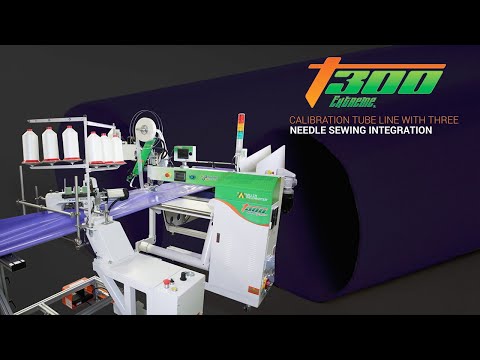
Cal-Tube production uses bonding technology similar to rehabilitation liner, but with different material specs and dimensional requirements. Some Miller Weldmaster customers produce both products on the same or similar machine configurations, and Miller Weldmaster can configure systems to run rehab liner and Cal-Tubes together, letting producers streamline their operation.
Machine Types: Welding, Sewing, and Combined Systems
The bonding method your machine uses determines what liner constructions it can produce. There are three options: hot air welding, hot wedge welding, and industrial sewing. Double-layer liner production requires both a sewing and a welding system operating inline simultaneously.
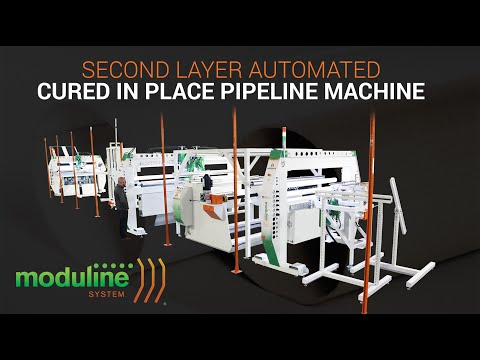
Miller Weldmaster's CIPP machines include the CIPP Single or Double Layer tube welding machine (sews or welds felt and coated felt inline, tack welds the layers and tapes the sewn seam), the CIPP Double Tube Sewing System (sews a pre-formed tube with a prayer seam), the Calibration Tube System (automated tube seaming with parallel and perpendicular welding and cut to length) and the T300 Flex hot air and hot wedge welder. Complete automated lines are on the automated CIPP solutions page, and every CIPP machine is in the machine finder.
Hot Air Welding for CIPP Liner
Hot air welding uses a stream of heated air to soften thermoplastic coating layers, then bonds them under nip roller pressure. It is well suited for coated fabrics with PVC, polyurethane, or polyethylene outer layers. Miller Weldmaster’s hot air systems are configured for long continuous seam runs — not short-cycle general industrial use.
Important: Not all fabrics can be heat-welded. Non-woven felt without a thermoplastic coating cannot form a weld bond — it requires sewing. If your liner uses a raw felt inner layer, you need a sewing head in the system.
After welding, the liner may be cured using hot water or steam to activate the resin and complete the curing process.
Hot Wedge Welding for CIPP Liner
Hot wedge welding passes a heated element directly between two thermoplastic fabric layers, melting the surfaces before they are pressed together. It delivers consistent seam geometry at higher production speeds than hot air on some material combinations, and produces tighter seam tolerances on specific thermoplastic coatings.
For buyers comparing hot air versus hot wedge: the right choice depends on your specific material spec and target production speed. Miller Weldmaster will specify the appropriate bonding technology after reviewing your liner construction.
Industrial Sewing for Non-Woven Felt Liners
Non-woven polyester felt — the standard inner layer for most CIPP rehabilitation liner — cannot be heat-welded. It requires industrial sewing. Miller Weldmaster’s sewing systems are heavy-duty industrial configurations, not light-gauge textile equipment. They are built to handle the material weights and continuous run lengths that CIPP production demands.
For double-layer liner, Miller Weldmaster systems can sew one layer of felt and weld a second coated layer in a single inline pass. This means the equipment can handle two layers simultaneously, efficiently bonding both the inner and outer materials in one operation.
| Bonding Method | Best For | Material Compatibility |
|---|---|---|
| Hot Air Welding | Continuous long seam on coated fabrics | PVC, polyurethane, polyethylene coated felt |
| Hot Wedge Welding | High-speed thermoplastic seam bonding | Thermoplastic coated fabrics |
| Industrial Sewing | Non-woven felt, uncoated inner layers | Non-woven felt, fiber reinforced materials |
| Combined (Weld + Sew) | Double-layer liners (felt inner + coated outer) | Mixed material constructions |
Single Layer vs. Double Layer CIPP Liner Production
Liner construction determines machine configuration. Before you can spec a machine, you need to know which liner type you are producing.
Single-layer liner requires a simpler machine configuration. Double-layer liner requires an inline combined system that handles two material paths and bonds fabric simultaneously, supporting roll production continuous operation. Most commercial sewer rehabilitation liner produced at scale is double-layer construction.
If you are unsure which construction your target market requires, Miller Weldmaster’s engineering team can walk through liner specifications with you before a machine is configured.
Here is the practical distinction:
| Construction | Description | Typical Application |
|---|---|---|
| Single Layer | One ply of non-woven felt or coated fabric formed into a tube | Smaller diameter, lower-pressure applications |
| Double Layer | Non-woven felt inner + coated outer layer bonded simultaneously | Structural sewer rehabilitation, larger diameters |
| Multi-Layer (custom) | Additional reinforcement layers for extreme diameter or pressure | Industrial pipelines, large infrastructure |
How to Choose a CIPP Welding Machine
Key Machine Components to Evaluate Before You Buy
The right CIPP liner welding machine is one that is configured for your specific liner construction, material specification, and production volume targets. Machines are available in a range of sizes to support different project requirements and can process various materials, including non-woven felt and coated felt, enabling the production of multi-layer products with varying characteristics. These factors ultimately determine whether a system will perform reliably — and continue performing — in production. Following proper safety standards during machine operation is also essential to ensure correct installation, prevent damage, and deliver a safe, dependable repair outcome.
Heavy-Duty Unwind System
CIPP materials arrive on large, heavy rolls. A commercial unwind system must handle roll weight without compromising feed tension as the roll diameter decreases. Inadequate unwind design is a hidden production problem — it shows up as material wander, uneven seams, and inconsistent liner dimensions downstream.
Ask suppliers what roll weight their unwind is rated for, and whether tension is actively controlled or passively managed through material drag.
Tension and Feed Control
Consistent tension through the full feed path is not optional — it is the foundation of seam quality. Too much tension distorts the fabric. Too little causes material bunching at the bonding zone. Automated tension control removes the operator as a variable, which is a requirement for production-grade CIPP systems, not a feature upgrade.
Manual tension adjustment systems are adequate for short-run prototyping. They are not adequate for commercial-scale liner production.
Seam Bonding Zone Configuration
The bonding zone is where liner is made. Proper seam bonding ensures the liner material is evenly distributed for optimal performance. Configuration must match your liner’s seam type and material construction:
- Overlap seam: the material edges overlap before bonding. Produces a slight thickness increase at the seam. Common in sewer rehabilitation liner.
- Butt seam: edges are joined end-to-end with a bonding tape or direct weld. Maintains uniform wall thickness. Required for applications where dimensional consistency at the seam is critical.
Seam type has downstream installation implications — confirm with your installer before locking in machine configuration.
Outfeed and Roll Production System
The outfeed determines how finished liner is collected after bonding. Continuous roll production is standard for volume liner manufacturing. The outfeed speed must match bonding zone throughput — a mismatch creates either material accumulation upstream or tension loss downstream. Both damage liner quality.
Confirm outfeed capacity when reviewing machine specs. This is a common oversight that surfaces during production ramp-up.
Operator Interface and Safety Systems
Automated CIPP systems require minimal operator intervention during a production run. The interface still needs to support quick parameter adjustments, temperature monitoring, and fault response without stopping the line unnecessarily. However, trained professionals are essential for operating and maintaining these automated CIPP systems safely and efficiently, ensuring that all safety protocols and operational standards are met.
Relevant factors to confirm: emergency stop systems, temperature control precision, sensor-based fault detection, and CE marking for operations or export to European markets.
Key Questions to Ask When Evaluating Equipment
Ask every supplier these six questions about the unwind, tension control, bonding zone, outfeed, operator interface and electrical compliance before you buy.
| Component | What to Ask | Why It Matters |
|---|---|---|
| Unwind System | What is the rated roll weight? Is tension actively controlled? | Consistent feed prevents downstream seam defects |
| Tension Control | Is tension automated or manual? What is the control range? | Automated control removes operator variability from seam quality |
| Bonding Zone | What seam types are supported? Can bonding method be changed? | Configuration must match your liner spec exactly |
| Outfeed System | What is the maximum outfeed speed? Does it match bonding zone throughput? | Speed mismatch causes material stress or seam failure |
| Operator Interface | Is the HMI intuitive? What fault detection and reporting is included? | Downtime response speed depends on interface clarity |
| Certifications | Is the system CE marked? What electrical standards does it meet? | Required for export markets and some domestic compliance contexts |
In-House Production vs. Purchasing Liner: The Real Cost Calculation
Most liner installers start by purchasing liner from a manufacturer. However, in-house production is a cost effective solution that increases productivity, saves time, and reduces labor costs. At a certain production volume, bringing liner manufacturing in-house becomes not only more efficient but also offers significant cost effectiveness and productivity benefits. The decision to bring liner manufacturing in-house is a capital investment decision — and it requires an honest look at the numbers.
What Drives the Cost Comparison
The core variables in the build-vs-buy calculation:
- Per-foot material cost: purchased liner includes the manufacturer’s margin, transportation, and packaging. In-house production replaces this with raw material cost plus machine amortization and labor — typically a lower per-foot figure at scale.
- Lead time control: purchasing liner means you are subject to the supplier’s production schedule. In-house production means you run when your project pipeline demands it, helping to minimize downtime by allowing immediate response to project needs. For installers managing multiple concurrent projects, this control has real operational value.
- Specification flexibility: purchased liner comes in standard configurations. In-house production lets you adjust wall thickness, felt weight, and coating spec to match project requirements — without a minimum order requirement or a lead time penalty.
- Margin capture: liner is a significant cost component in a CIPP project. Producers who manufacture their own liner capture the manufacturer’s margin on every foot they install.
“Humphrys has been extremely satisfied with Miller Weldmaster's ability to make us custom heat seaming machinery that has improved our productivity and reduced our labor costs.”
When In-House Production Makes Sense
Not every operation should manufacture their own liner. Volume is the key variable. Below a certain production threshold, machine amortization outweighs the per-foot savings. Above it, in-house production consistently produces better economics.
Strong candidates for in-house production typically share these characteristics:
- They are currently purchasing liner on a recurring basis for large-diameter or high-volume projects.
- They want control over their production schedule and cannot afford supply chain delays.
- They have identified liner cost as a significant margin compression factor in their project bids.
- They produce or want to produce both rehabilitation liner and calibration tubes.
For these operations, in-house liner manufacturing improves scheduling flexibility, reduces supplier dependence, and provides greater control over liner quality. Over time, it can strengthen margins and support scalable growth.
Why Miller Weldmaster for CIPP Liner Manufacturing Equipment
Miller Weldmaster has been building industrial fabric welding and sewing systems since 1974. The CIPP liner manufacturing systems they produce are not adapted from a general-purpose welding platform — they are engineered specifically for the material weights, run lengths, and seam tolerances that liner production demands.
Proven at Scale: Millions of Linear Feet Worldwide
Miller Weldmaster’s CIPP liner manufacturing systems have produced millions of linear feet of liner across installations worldwide. That production volume is not a marketing claim — it reflects the operational record of systems running in liner manufacturing facilities across multiple markets and geographies.
For buyers evaluating a capital equipment purchase, operational track record matters more than feature specifications. A machine that has performed at production scale is a different proposition from one that has not.
Custom Configuration for Your Liner Construction
Miller Weldmaster does not sell a standard off-the-shelf CIPP machine. Every system is configured for the buyer’s specific liner construction, material spec, diameter range, and production volume target.
That means the machine you receive is not a general-purpose system that has been adapted. It is a system engineered for what you are making. Single-layer or double-layer, weld only or combined weld and sew, overlap seam or butt seam, specific outfeed requirements — each variable is addressed in the configuration process before the system ships.
Post-Sale Support: Training, Parts, and Ongoing Service
The Miller Weldmaster value proposition does not end at delivery. Operator training is included with every system. Spare parts are stocked. A service team is available to support production continuity after installation.
For buyers evaluating long-term production reliability, this matters. A CIPP liner manufacturing system is a production-critical piece of equipment. A supplier who can provide fast spare parts and responsive technical support protects your production schedule.