Non-woven polyester welding is the process of bonding non-woven polyester or polypropylene fabrics using heat-based technology — primarily hot air — to create durable, sealed seams for industrial applications including geotextiles, filtration products, and cured-in-place pipe.
This page covers what makes non-woven polyester weldable, how to match the right welding method to your material, and how Miller Weldmaster's machines are engineered for the specific behavior of non-woven fabrics — from lightweight filtration applications to heavy-gauge geo-liner and CIPP production.
- Hot air welding is the primary joining method for non-woven polyester and polypropylene — the fiber structure responds to controlled heat and fuses cleanly under roller pressure without melting through or deforming the material.
- The three most common end-products made from welded non-woven polyester are geo-liners, filtration tubes, and cured-in-place pipe (CIPP) — each requiring different seam widths, material weights, and machine configurations.
- Non-woven polyester does not absorb moisture but does absorb oil, and it keeps its shape over time, making it a common choice in drainage, filtration, and underground infrastructure applications.
- RF (radio frequency) welding is not compatible with non-woven polyester. The material lacks the dielectric properties required to generate internal heat under an RF field. Hot air and ultrasonic are the correct methods.
- Miller Weldmaster has engineered fabric welding machines since 1974, with solutions ranging from semi-automated bench-top systems to fully automated production lines for geo-liners, filtration tubes, and CIPP.
What Is Non-Woven Polyester?
Understanding what non-woven polyester is — and how it behaves — is the first step in selecting the right welding technology. The material's fiber structure, thermal properties, and chemical profile all directly affect weld quality, machine configuration, and end-product performance.
Non-Woven Polyester and Nonwoven Fabrics Defined
Non-woven polyester is a synthetic textile manufactured from bonded or entangled polyester fibers rather than woven or knitted threads — giving it uniform porosity, dimensional stability, and multidirectional strength without the structural bias of a woven fabric.
The manufacturing process determines the fabric's weight, fiber density, and weld behavior. The three most common production methods are:
- Needle-punch: Fibers are mechanically entangled using barbed needles. Produces heavier-weight fabrics suited for geotextiles, filtration, and geo-liner applications.
- Spunbond: Continuous polyester filaments are extruded and thermally bonded. Produces consistent, lighter-weight fabrics used in filtration and medical protective products.
- Thermal bonding: Fibers are fused at contact points using heat. Common in lightweight and specialty industrial applications.
The term "non-woven" applies to both polyester and polypropylene fabrics. Both are welded on the same Weldmaster equipment, but their material properties diverge in ways that matter for application selection — compared in the next section.
Polyester or Polypropylene?
Non-Woven Polyester vs. Non-Woven Polypropylene — Which Should You Weld?
Both non-woven polyester and polypropylene are welded using hot air technology on Miller Weldmaster equipment. The choice between them is driven by the application's performance requirements, not welding method.
If you're running both materials on a production line, Weldmaster machines are configurable for both polyester and polypropylene, letting operators adjust heat and speed settings for each material's thermal profile without requiring a separate machine.
Key Material Properties That Make It Weldable
| Material Property | Why It Matters for Welding & Application |
|---|---|
| Thermoplastic fiber structure | Fibers soften and fuse under controlled heat without melting through — the core mechanism that makes hot air welding effective. |
| Moisture resistance | Non-woven polyester does not absorb water, maintaining dimensional stability in buried, submerged, or high-humidity environments like geo-liners and drainage systems. |
| Oil absorption | Polyester absorbs oil but not water, so it stays dimensionally stable in wet, oily filtration environments. |
| Biological and chemical resistance | Resists degradation from microorganisms, UV exposure, and a wide range of chemicals — critical for long-service-life applications like cured-in-place pipe and geotextiles. |
| Tensile strength without directionality | Non-woven construction distributes load uniformly in all directions. Weld seams must match or exceed this base strength to avoid becoming the failure point. |
| Fiber bond density | Denser fiber bonding (spunbond vs. needle-punch) affects heat transfer rate and required weld parameters — machines must accommodate this variability. |
Why Welding Is the Right Joining Method for Non-Woven Polyester
Manufacturers evaluating their joining options typically consider sewing, adhesives, or welding. For non-woven polyester in industrial applications, welding is usually the better choice — and the reasons go beyond convenience. Seam integrity, production consistency, and performance under real operating conditions all favor thermal welding over the alternatives.
Welded Seams vs. Sewn Seams — Performance Under Real Conditions
Sewing non-woven polyester introduces needle perforations along the seam line. In a drainage fabric or geo-liner, those holes are pathways for moisture infiltration, pressure loss, or particulate bypass — compromising the product's core function.
A properly executed hot air weld on non-woven polyester achieves seam strength comparable to or exceeding the base material, depending on material weight and weld parameters. The seam is continuous, watertight, and presents no perforation risk across the full length of the product.
In cured-in-place pipe applications, this matters at a structural level: the liner seam must survive internal pressure during resin injection and cure, followed by long-term underground loading. That is why Miller Weldmaster’s CIPP lines either weld the seam or sew it and seal it with hot-air tape, so the finished tube is waterproof. In geo-liner manufacturing, seam failure in the field means remediation costs that far exceed the cost of welding equipment.
Welding vs. Adhesives for Non-Woven Polyester
Adhesive bonding introduces several variables that thermal welding eliminates:
- Chemical compatibility risk: Not all adhesives are compatible with polyester's surface energy and chemical profile. Incompatibility leads to bond degradation over time, especially in buried or chemically active environments.
- Cure time and production throughput: Adhesives require controlled cure time, limiting production speed. Hot air welding produces a finished seam in the same pass as the weld — no staging, no waiting.
- Seam inspectability: Welded seams are visually and mechanically inspectable in-line. Adhesive bond quality is difficult to verify non-destructively along a continuous seam.
- Application-specific incompatibility: In cured-in-place pipe production, adhesives are not a viable option. The seam must withstand internal pressure during resin cure and long-term underground installation loads that adhesive bonds cannot reliably deliver.
Welding Technologies for Non-Woven Polyester — How to Choose the Right Method
Non-woven polyester is not compatible with every welding technology. The right method depends on material weight, production volume, and seam requirements. Below is a practical guide to matching method to application — followed by the one technology buyers frequently ask about that does not work for this material.
Hot Air Welding
Hot air welding is Weldmaster's primary technology for non-woven polyester and polypropylene. The mechanism is direct: a precisely controlled stream of heated air is directed at the material's thermoplastic fibers, softening them to the weld temperature. Nip rollers then apply calibrated pressure to fuse the softened fiber zone, creating a continuous sealed seam as the material passes through the machine.
Why hot air over hot wedge for fiber-based non-wovens: hot wedge welding relies on direct contact between a heated metal surface and the material. For coated fabrics and HDPE geomembranes, this works well. For fiber-based non-wovens, direct contact can displace or compress the fiber structure unevenly before the weld zone is fully formed. Hot air avoids this by delivering heat through the air column rather than through contact, producing more consistent fiber-to-fiber fusion across the seam width.
Weldmaster hot air systems for non-woven polyester are configurable for:
- Seam width: adjustable to match geo-liner, filtration tube, or CIPP seam geometry requirements
- Material thickness range: from lightweight spunbond (low heat input) to heavy needle-punch geo-liner stock (high heat output and pressure)
- Production speed: variable speed control maintains consistent weld quality across different material weights
- Single-pass and multi-pass configurations for laminated or multi-layer products
Ultrasonic Welding
Ultrasonic welding uses high-frequency vibration to generate frictional heat at the bond line at the fiber-to-fiber interface without extra adhesives or external heat sources. Instead, the vibration energy converts to heat precisely where the material surfaces contact the ultrasonic horn and anvil.
For non-woven polyester, ultrasonic welding is the right choice when:
- Material is thin-gauge and requires a clean, precise seam without thermal spread.
- Seam patterns are complex, such as the curved, radius-welded ends of filter bags.
- Production requires minimal heat exposure to surrounding material, such as in applications where the non-woven is adjacent to heat-sensitive components.
Miller Weldmaster’s Filter Ultrasonic Welding unit radius-welds the ends of filter bags and can be added to any T300 continuous system for a fully automated line. The Ultrasonic Cutter cuts and seals fabric edges in one step, so cut edges do not fray.
For heavy-gauge geo-liner and CIPP non-wovens, hot air is the preferred method. The material mass requires sustained heat input over a wider weld zone than ultrasonic can efficiently deliver at production speeds.
Welding Methods for Non-Woven Polyester — and Why RF Does Not Work
| Welding Method | How It Works | Best for Non-Woven Polyester? | Typical Applications |
|---|---|---|---|
| Hot Air | Heated air stream softens thermoplastic fibers; nip rollers apply pressure to fuse the seam. | Yes — primary method for medium-to-heavy-gauge non-woven polyester and polypropylene. | Geo-liners, geotextiles, CIPP liners, filtration tubes, drainage fabrics. |
| Ultrasonic | High-frequency vibration generates friction heat at the fiber interface, bonding without external heat source. | Yes — best for thin-gauge non-woven materials where precision seam patterns are required. | Filter bag ends (radius welds), thin filtration fabrics, precision industrial non-wovens. |
| RF (Radio Frequency) | Electromagnetic field causes polar molecules to oscillate and generate heat internally. | No. Non-woven polyester has a low dielectric constant and does not generate internal heat under RF. Not compatible. | PVC, polyurethane, and other polar-molecule materials only. |
| Hot Wedge | A heated metal wedge contacts material surfaces directly to generate a melt zone before pressure bonding. | Used less often for fiber-based non-wovens; best suited to coated fabrics and HDPE geomembranes. The T300 Flex and T600 Flex carry both hot air and hot wedge. | HDPE geomembranes, coated tarpaulins, coated fabrics. |
Applications of Non-Woven Polyester Welding — Industries Weldmaster Serves
Non-woven polyester is a material, not an industry category. The applications below represent distinct end-products with specific seam requirements, material weights, and production volume profiles. Each demands a different machine configuration — which is why application-first machine selection is the right starting point.
Geo-Liners and Geotextiles
Non-woven polyester geotextiles serve four primary functions in civil engineering and construction applications: drainage, separation, filtration, and erosion control. The material's resistance to biological degradation, UV exposure, and a wide pH range makes it the preferred choice for buried or permanently submerged installations.
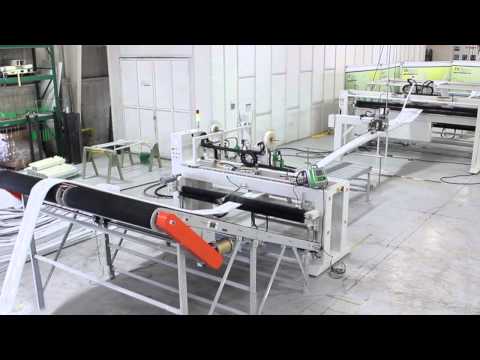
In geo-liner manufacturing, seam length runs to hundreds of meters and seam quality is a specification requirement — not a preference. Miller Weldmaster automated welding systems produce the long, straight, continuous seams that large-format geo-liner fabrication requires. Weld quality is consistent across the full run because the system controls heat, speed, and pressure as continuous parameters rather than relying on operator technique.
Filtration Products (Tubes and Bags)
Filtration tubes and bags require consistent seam widths and repeatable weld quality across every unit produced. Variation in the weld creates variation in filtration performance — an uneven seam can allow bypass of particulates or fluid, defeating the product's purpose.
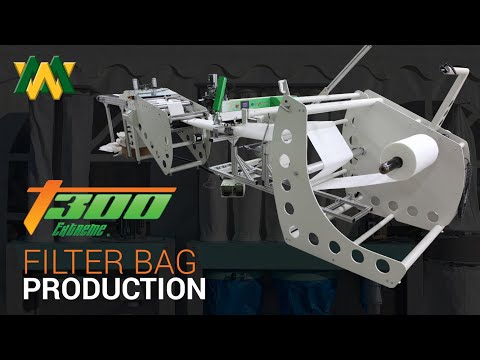
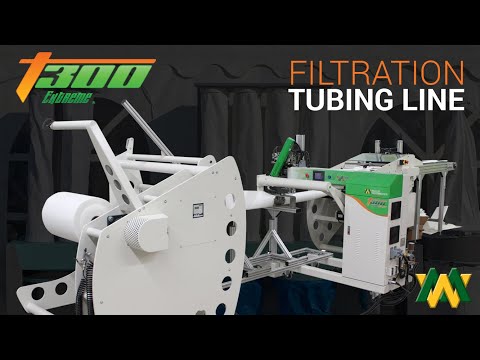
The Weldmaster T300 and continuous filter bag production line configurations handle this application range, producing consistent seam geometry across medium-to-heavy gauge non-woven polyester filtration stock.
Cured-In-Place Pipe (CIPP)
CIPP is the process of rehabilitating existing underground pipe infrastructure by inserting a resin-saturated liner that is then cured in place to form a new structural pipe within the old one. Non-woven polyester is the liner material of choice for CIPP because of three properties that matter at cure conditions: dimensional stability under heat, resistance to resin saturation bleed-through, and seam strength that survives both resin injection pressure and the post-cure structural loading of a live utility pipe.
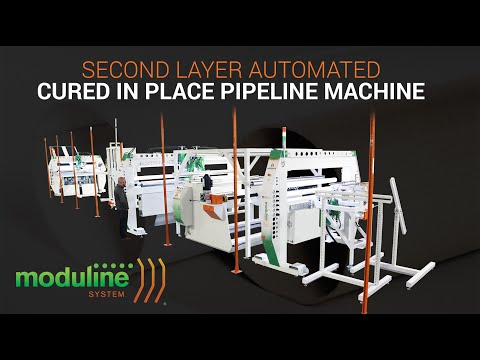
Buyers searching for cured-in-place pipe welding machines are typically deep in the evaluation process — they understand the application and are selecting a fabrication system for a specific production volume. Weldmaster automated CIPP welding systems handle both single-layer and two-layer tube fabrication, with seam geometry configured to the liner diameter and wall thickness specified.
Medical and Industrial Isolation Products
Non-woven polyester and polypropylene are used in isolation gowns and industrial protective products where consistent, clean seams are required without contamination. These are typically thin-gauge, spunbond materials where ultrasonic welding produces the precision seam patterns required by product standards.
How to Choose a Non-Woven Polyester Welding Machine
Machine selection starts with the application — not the equipment catalog. The four steps below give you the framework to match the right system to your material, seam requirements, and production volume before you evaluate any vendor.
Step 1 — Define Your Application and Seam Requirements
Different applications require different seam geometry, which determines machine configuration. Before evaluating machines, identify your material weight, required seam width and seam type, production volume, and material thickness range. These factors influence heat output, weld parameters, automation level, and machine compatibility. Knowing these details helps ensure you select the right welding equipment for your specific needs.
Step 2 — Match Material Weight to Machine Capacity
Machine heat output, roller pressure, and speed range must match your material weight. For heavy-gauge geo-liners and geotextiles, fully automated hot air systems with high heat output and wide welding widths are recommended. Medium-gauge filtration tubes and bags suit semi-automated or automated systems like the T300 Extreme Filter System. Heavy-gauge, multi-layer cured-in-place pipe requires automated CIPP welding lines. Light-gauge medical and protective products are best processed with bench-top or semi-automated ultrasonic or low-heat hot air systems.
Step 3 — Evaluate Automation Level for Your Production Volume
The automation decision directly corresponds to production volume and labor costs. Manual or semi-automated systems suit prototyping and low-volume runs with frequent product changes. Fully automated systems are ideal for high-volume production of filtration tubes, CIPP liners, and geo-liners, ensuring consistent quality and labor efficiency. Miller Weldmaster offers machines for both ends of this spectrum, eliminating operator-dependent weld variation in large-scale manufacturing.
Step 4 — Ask These Questions Before Buying
A smart buyer should ask any welding machine vendor these key questions: What is the machine's rated material thickness and weight range for non-woven polyester? What seam widths and shapes can the machine achieve, and how are these adjusted? Is the machine configurable for both non-woven polyester and polypropylene without hardware changes? What heat control precision and features ensure consistent welding during long production runs?
Why Manufacturers Choose Miller Weldmaster for Non-Woven Polyester Welding
The relevant question is not whether Weldmaster makes welding machines — it's whether those machines are engineered specifically for the behavior of non-woven polyester and polypropylene, and whether the company has the application depth to help you select and configure the right system for your specific product.
Fabric Welding Application Engineering Since 1974
Miller Weldmaster has been engineering welding solutions for industrial fabrics since 1974. Non-woven polyester and polypropylene applications — including geo-liners, filtration tubes, and CIPP — have been part of that application base for decades. The machine designs reflect that accumulated application knowledge, not a general-purpose welding platform adapted for fabric.
Named machine lines like the T300 and the automated CIPP welding systems are the result of iterating on real customer applications in geosynthetics, filtration, and infrastructure — not catalog products developed from generic specifications.
Machines Built for Non-Woven Polyester's Specific Behavior
Non-woven polyester requires precise temperature control and consistent roller pressure to avoid two failure modes: fiber delamination (under-welded — insufficient heat or pressure) and seam bleed-through (over-welded — excessive heat melts through the fiber matrix rather than fusing it).
Weldmaster machines address this with adjustable heat and speed parameters that accommodate material variability across weights, fiber densities, and production speeds. The control architecture is not a general hot air system — it is tuned for the thermal profile of non-woven fabrics.
This matters in production because real material rolls vary. Fiber density is not perfectly uniform across a roll or between rolls from the same supplier. A machine without fine heat and pressure control will produce weld variation as the material varies. Weldmaster's systems are designed to maintain seam quality across that variability.
See how Miller Weldmaster’s non-woven polyester welding machines perform across filtration, geo-liner, and CIPP production environments.
Choose Miller Weldmaster for Your Welding Machine Needs
Miller Weldmaster builds hot air welders, automated sewing lines and ultrasonic add-ons for non-woven polyester and polypropylene, used to make filter bags, geo-liners and CIPP tubes. Choosing the right setup starts with your product and your production volume.
How To Get Started with Miller Weldmaster:
Step 1: Define Your Requirements
Assess your material requirements and production volume needs with Miller Weldmaster’s expert guidance.
Step 2: Evaluate Your Workspace
Evaluate workspace constraints and automation benefits tailored to your application by Miller Weldmaster specialists.
Step 3: Connect with an Expert
Contact Miller Weldmaster equipment experts to discuss specific machine capabilities, request demonstrations, and receive personalized support to optimize your welding process.
If you do not see your fabric listed to the left, please contact us and tell us about your fabric welding needs.